
India won’t be bullied by Trump, Doval told Rubio; govt was willing to wait out US president’s term, says report | India News – The Times of India
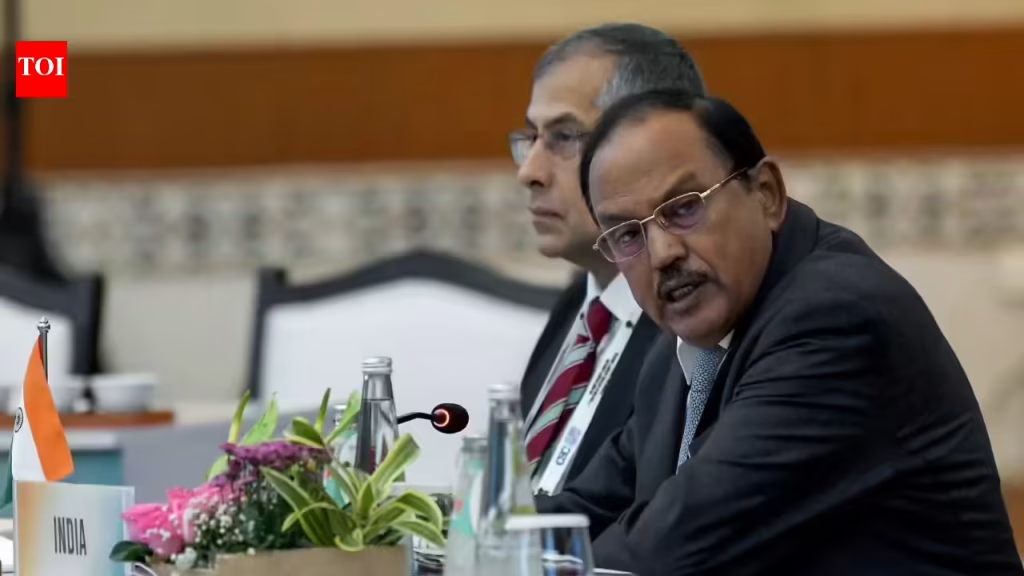
NEW DELHI: As India is finalising the details of its trade deal with the US, a report suggested that the Narendra Modi-led government was willing to wait out US President Donald Trump‘s term for the trade agreement and Washington was also informed of the same.According to a report by news outlet Bloomberg, national security adviser Ajit Doval held a meeting with US secretary of state Marco Rubio in September last year and told him that India won’t be bullied by Trump or his top aides.Doval told US officials that the Modi government was willing to wait out Trump’s term, having faced other hostile US administrations in the past.Doval also told Rubio that New Delhi wanted Trump and his aides to dial down their public criticism of India so they could get relations back on track.This comes after the US President announced a trade deal with India on Monday, slashing tariffs from 50 per cent to 18 per cent.“It was an Honor to speak with Prime Minister Modi, of India, this morning. He is one of my greatest friends and, a Powerful and Respected Leader of his Country. We spoke about many things, including Trade, and ending the War with Russia and Ukraine. He agreed to stop buying Russian Oil, and to buy much more from the United States and, potentially, Venezuela,” Trump announced in a social media post on Truth Social.Earlier on Tuesday, Union commerce minister Piyush Goyal said that the “much-awaited trade deal” with the US has been successfully concluded.“The much-awaited trade deal with the United States of America has been successfully concluded. This is a significant trade agreement, finalised last night under the leadership of Prime Minister Narendra Modi, keeping the interests of the nation and its people in mind,” Goyal said.“It is a deal that will further strengthen India’s future. I thank Prime Minister Modi on behalf of 1.4 billion citizens and congratulate everyone, as this is a landmark achievement for the country,” he added.Goyal also said that the government has protected the sensitive sectors of India’s economy — particularly agriculture and dairy. “In the US trade deal, the sensitive sectors of India’s economy, particularly agriculture and dairy, have been protected. We have seen reports from across the country; there is widespread enthusiasm,” he said.Further, he added that both countries will shortly issue a joint statement along with the details, which we will shortly be signing between the United States of America and India.“We stand for the people of India. We stand for national interest. And today, 140 crore Indians are celebrating a trade deal which is under final stages of detailing between the negotiating teams of both countries. We will be shortly issuing a joint statement by both countries along with the details which we will be shortly inking between the United States of America and India. And as soon as the final understanding of the deal is inked and the joint statement is finalised. Technical processes are completed. Full details will be shared,” the minister said.“But I can assure the people of India. I can assure 140 crore brothers and sisters that this is a deal that will make every Indian proud. That will protect the interest of every Indian and provide huge opportunities for all the people of India and will protect the sensitive sectors,” he added.Prime Minister Narendra Modi and US President Donald Trump agreed to deepen bilateral trade ties, setting a target of more than doubling trade to $500 billion by 2030.Talks began in March 2025, saw multiple rounds of negotiations and delegations on both sides, but were jolted by the imposition of import duties on Indian goods, which were escalated to 50 per cent.2025 saw several chapters of formal negotiations and multiple backchannel engagements for both the countries to come to an agreement.