
Govt collects health cess, but spends less than it did earlier | India News – The Times of India


Despite collecting a cess specifically for health, the Centre’s spending on health is now lower than it was before the cess was imposed, both as a share of the total budget and as a proportion of the GDP.Before the health cess was introduced in 2018, the allocation for health was 2.4% of total govt expenditure in 2017-18. In the Budget Estimates for 2026-27, that is down to 1.9%. As a proportion of the GDP, the decline is from 0.28% to 0.26%. Money collected as health cess amounts to over 30% of the allocation for health and family welfare in 2026-27. Without the cess component, health would have accounted for just 1.3% of the total Budget, barely over half of the figure in 2017-18.
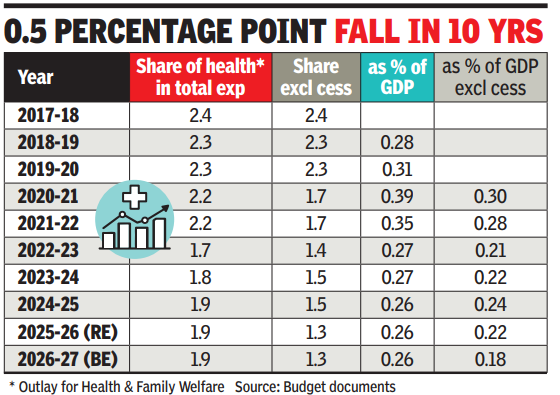
0.5 percentage point fall in 10 years
When the health cess was introduced, the understanding was that it would boost health expenditure by topping up what the govt was already allocating. Clearly, that has not happened. Instead, cess is masking what would otherwise be a steep cut in the share of health in total Budget and in GDP. From 0.32% of the GDP in 2019, the year before Covid struck, the share has fallen to 0.27% even with the cess component. Remove the cess component and the share of health in the GDP is 0.18%. The target of the National Health Policy was 2.5% of the GDP by 2025 of which 35% was supposed to be the share of central govt, which works out to 0.9% of the GDP or Rs 3.5 lakh, over three times the current allocation.If we were to strip the cess money off the revised Budget allocation for 2025-26 which was Rs 92,926 crore, it would be Rs 78,279 crore. Do the same for the 2026-27 allocation and it falls to Rs 70,984 crore, which is 9.3% lower than the 2025-26 revised allocation without cess.We could look at it differently. If govt were to allocate the same share (2.4%) of the total Budget as it did in 2017, the allocation this year would have been Rs 1.2 lakh crore without the cess. Instead, even with cess the allocation has been just Rs 1 lakh crore.“The health and education cess flatters the health allocation without increasing allocation from the consolidated fund. Cess money flows from a reserve fund outside the regular Budget process, with no outcome monitoring requirements. Moreover, cess requires no parliamentary accountability. You create the impression of increased Budget allocation but in reality, states have no claim on cess. It is entirely the discretion of the central govt,” said economist Dr Varna Sri Raman.In 2018, then finance minister Arun Jaitley introduced the health cess, saying the 3% education cess was being increased to 4% health and education cess “in order to take care of the needs of education and health of BPL and rural families”. “Though it is assumed the additional 1% is for health, the Finance Act doesn’t prescribe how the 4% is to be divided between health and education. Central govt decides each year how much goes into Pradhan Mantri Swasthya Suraksha Nidhi (PMSSN) which is a fund created to hold the health component of the cess,” said Sri Raman. PMSSN was only created in 2021, two years after the cess was introduced.“The health cess collected from 2018-19 and 2019-20 went into the general revenues. That’s roughly Rs 20,600 crore collected in the name of health that went into general revenues with no earmarking,” she added.