
US-Israel attack on Iran: Former Iran supreme leader Ayatollah Khamenei to be buried in his hometown, Mashhad – The Times of India
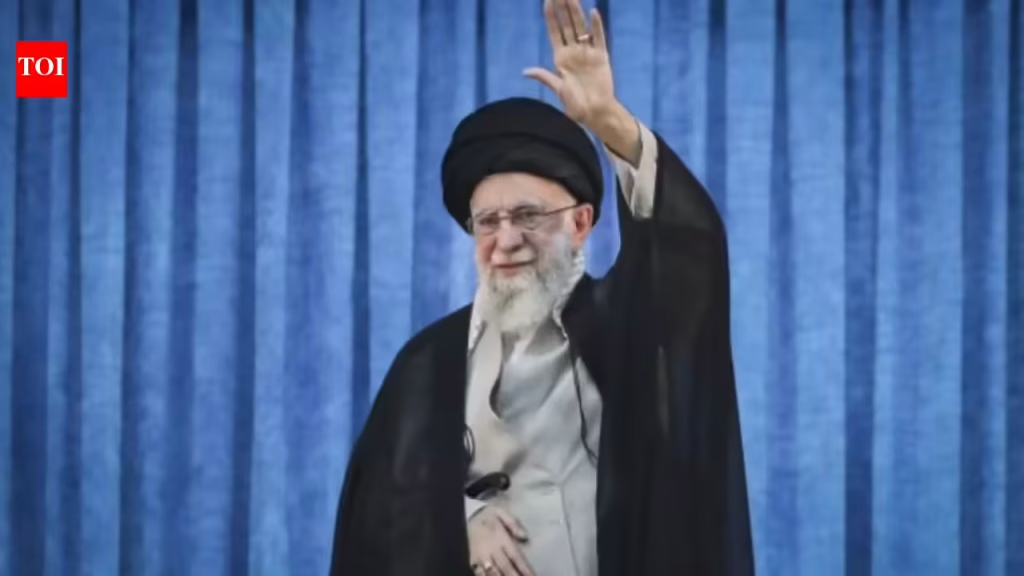
Iran’s former supreme leader Ayatollah Ali Khamenei, who was killed in a joint US-Israel strike on Saturday, will be buried in the holy city of Mashhad, Iranian media reported on Tuesday, as tensions continue to escalate across the Middle East following the high-profile assassination.The Fars news agency said Khamenei, who died at the age of 86 after leading the Islamic Republic for 36 years, will be laid to rest in Mashhad, Iran’s second-largest city and his birthplace. His father is buried at the Imam Reza shrine in the city. No date for the burial has been announced.Khamenei’s death, confirmed by Iranian authorities early Sunday, marks a dramatic escalation in the widening conflict between Iran and the United States and Israel, raising fears of prolonged instability across the region.
US and Israel confirm strike that killed Khamenei
US President Donald Trump announced Khamenei’s death, describing it as a decisive moment in the conflict.“Khamenei, one of the most evil people in History, is dead. This is not only Justice for the people of Iran, but for all Great Americans, and those people from many Countries throughout the World, that have been killed or mutilated by Khamenei and his gang of bloodthirsty THUGS,” Trump wrote on Truth Social.Earlier, Israeli Prime Minister Benjamin Netanyahu had said there were “many signs” that the Iranian leader was no longer alive, though he stopped short of a definitive confirmation at the time.According to US officials, the operation that killed Khamenei was a coordinated US-Israel air and naval strike dubbed “The Epic Fury.” It was reportedly timed to coincide with a high-level meeting of Iran’s top leadership.A US official said the strike was designed to target Khamenei first to preserve the element of surprise amid concerns that he might go into hiding if alerted.Iranian sources told Reuters that Khamenei had met on Saturday with senior figures including Shamkhani and Supreme National Security Council Secretary Ali Larijani at a secure location shortly before the strikes began.US intelligence agencies had monitored Khamenei for months. Reports said the CIA shared detailed intelligence with Israel indicating he would attend a meeting of senior officials in Tehran. Israeli intelligence independently confirmed the gathering, prompting the strike to be moved forward when it was detected earlier than expected.Satellite imagery reviewed by Reuters confirmed that Khamenei’s high-security compound in Tehran was destroyed at the start of the operation.The strike took place during the Muslim holy month of Ramadan and at the start of the Iranian workweek. Officials described it as the culmination of months of planning amid rising tensions over Iran’s nuclear programme and regional activities.
A defining figure in modern Iran
Ali Hosseini Khamenei was born on April 19, 1939, in Mashhad into a clerical family. He studied Islamic theology in Mashhad and later in Qom, where he came under the influence of revolutionary cleric Ruhollah Khomeini, the architect of the 1979 Islamic Revolution.Khamenei played an active role in the movement against Shah Mohammad Reza Pahlavi and was arrested several times before the monarchy collapsed. After the revolution, he rose steadily within the new Islamic Republic.In 1981, during the Iran-Iraq War led by Saddam Hussein, Khamenei was elected President of Iran. That same year, he survived an assassination attempt that left his right arm partially paralysed. He served as president until 1989.Following the death of Ayatollah Khomeini in 1989, Iran’s Assembly of Experts appointed Khamenei as Supreme Leader despite debates about his clerical rank. Over time, he consolidated authority under the doctrine of Velayat-e Faqih, or guardianship of the Islamic jurist.As Supreme Leader, Khamenei commanded the armed forces, appointed the heads of the judiciary and state broadcasting, and held decisive influence over foreign policy and national security. Although Iran held presidential and parliamentary elections, candidates were vetted by institutions aligned with his office.His tenure spanned reformist and conservative administrations, including those of Mohammad Khatami, Mahmoud Ahmadinejad and Hassan Rouhani, but ultimate authority remained concentrated in his office.In 2009, he backed the disputed election results that returned Ahmadinejad to power, triggering mass protests known as the Green Movement. Security forces cracked down on demonstrators, reinforcing the centralised authority of the Supreme Leader.On foreign policy, Khamenei oversaw an assertive regional strategy. Iran expanded its influence in Lebanon, Iraq, Syria and Yemen and supported the government of Bashar al-Assad during the Syrian civil war. Relations with Israel remained openly hostile throughout his leadership.The Iranian nuclear programme was a defining issue of his rule. In 2015, Iran reached a nuclear deal with world powers under President Rouhani. However, President Trump withdrew the United States from the agreement in 2018 and reimposed sanctions, deepening tensions.Under sustained sanctions, Khamenei promoted a “resistance economy” aimed at reducing dependence on Western markets. His later years were marked by economic hardship, inflation and repeated waves of unrest, including protests in 2009, 2019 and 2022.Supporters described him as a defender of Iran’s sovereignty against foreign pressure. Critics argued that political freedoms narrowed significantly during his tenure and that power became increasingly centralised around the Supreme Leader and institutions such as the Islamic Revolutionary Guard Corps.
Fallout and regional consequences
Khamenei’s killing has intensified an already volatile confrontation. Iranian officials have described the strike as an act of aggression and warned of consequences.The operation marked a significant expansion of direct US involvement in the conflict. Analysts say the death of Iran’s top leader could trigger retaliatory violence, destabilise internal political structures and complicate diplomatic efforts.The United States had recently deployed one of the largest concentrations of warships and aircraft in the Middle East in decades. While publicly calling for negotiations to curb Iran’s nuclear ambitions, Washington had also warned of military consequences if Tehran resumed enrichment activities.US intelligence assessments indicated that Iran had developed the capability to produce high-quality centrifuges domestically, an essential component for enriching uranium. Although Tehran said it had not enriched uranium since June, it restricted access for international inspectors to sites previously targeted in strikes.Satellite imagery analysed by independent observers showed renewed activity at some of those locations, suggesting efforts to assess damage and potentially recover material.Trump framed the strike as necessary to prevent what he described as a resurgence of Iran’s nuclear capabilities. The attack, however, has raised fears of wider conflict across the Gulf and beyond.Khamenei’s burial in Mashhad, home to the Imam Reza shrine and one of the most sacred sites in Shia Islam, is expected to draw large crowds and could become a focal point for both mourning and political messaging.As Iran prepares for the funeral of the leader who shaped its politics for more than three decades, the region faces an uncertain future. The removal of such a central figure in Iran’s power structure leaves questions about succession, internal stability and the trajectory of the conflict with the United States and Israel.