
Arunachali Women Racially Attacked In The National Capital: Delhi’s Many Faces And The “Others” It Forsakes
There exist millions of edits romanticizing Delhi on the internet; some about the bliss Lodhi Garden brings, some about the historical monuments Mughals have built, some about the food, some about the markets. Even Mirza Ghalib, centuries ago, wrote, “I asked my soul: What is Delhi? She replied, “The world is the body, and Delhi its life!” And yet, as Delhi’s boulevards gleam and its bazaars buzz with commerce, for many of its inhabitants, it holds the peril of prejudice.
Stereotypes, more often than not, flatten human complexity into false and crude assumptions. People are categorised, their identities turn into shame and for us who supposedly live in a civil society, one does not have to imagine the consequences, for they are in front of us. Stereotypes normalise exclusion and discrimination and make it acceptable even. When communities are reduced to racial, caste, class and gendered prejudice, it normalises a society which gets to dictate accessibility to housing, education, and employment, and over the course of time, it also takes the form of structural biases. Stereotypes, racism, sexism, and all other forms of “-isms” also kill.
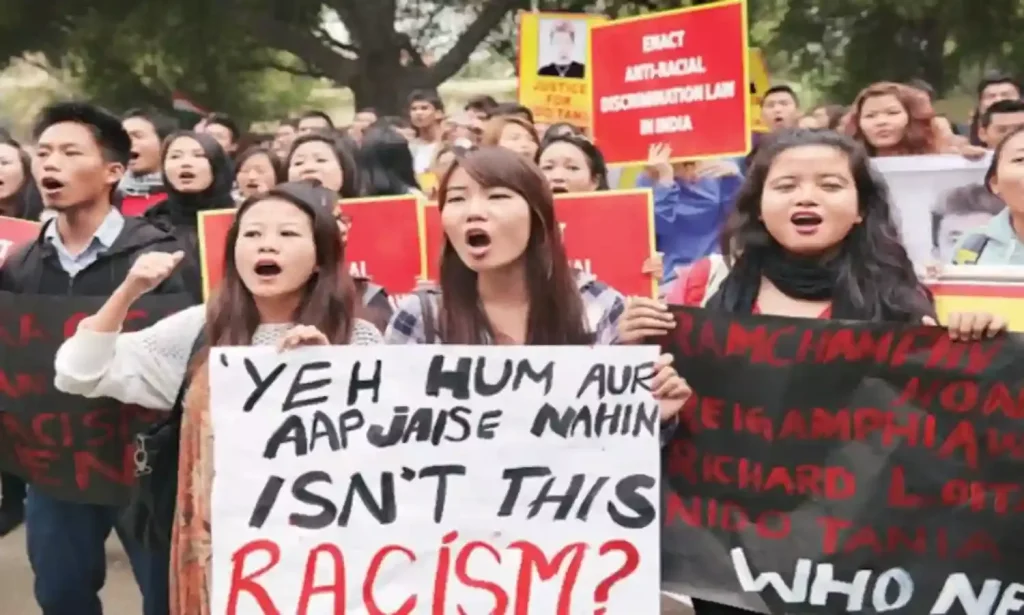
For people from the Northeast who migrate to the city in search of quality education and employment, they have to confront the everyday racism, sexism and cultural alienation which have unfortunately become perpetual. It starts in schools, colleges, universities and later on in employment spaces. These racial attacks also take violent forms, including rape, murder, assault, etc. which have been reported in Delhi for years.
Arunachali women face racial attacks in Malviya Nagar and also face sexism
In a recent incident, three young students from Arunachal Pradesh, who lived in a rented flat, were subjected to violent racial abuse in Delhi’s Malviya Nagar over something as little as dust falling due to an AC installation. Sentences such as “Northeast people are shit” and “500 rupees me parlour me kaam karti ho, dhandhevaliyo”, along with other misogynistic and stereotypical slurs, were yelled at their faces. While race was the most visible axis of oppression, gender was also at play here. The word “Dhandhevaliyo” is deeply politically loaded. In colloquial North Indian usage, “dhandha” can mean “business,” but when directed at women, it is widely understood as a slur implying sex work.
The three women in Malviya Nagar lived in a rented apartment which also gives us another implication of class. Northeastern people already face an issue with rented spaces. They often face comments such as “Your food is smelly”, “You don’t speak Hindi?” and many others laced with racism.
In the article linked above, the Meghalayan student talks about how an auto driver in Delhi indirectly linked them to prostitution, while north-eastern women are followed by men who seek to “sleep with them.” The stereotype that north-eastern women are “morally loose”, and “sexually available”, while their facial features, clothing choices, and cultural differences are exoticised and then weaponised, feeds into a deeply racist and sexist imagination.
This “insult” only works because a woman’s perceived sexual respectability is still tied to her social worth. To call a woman “dhandhevali” is to humiliate and strip her of dignity, especially those who occupy urban spaces independently.
Caste? Class? Gender? Race? Or an intersection?
One also cannot overlook the class politics embedded in the word “Dhandhevali”. Sex work in India is heavily stigmatised and laced with poverty, caste marginalisation, and urban precarity. They face violence, police harassment, lack of labour protections, and social ostracisation. They are simultaneously exploited and shamed. The politics of that word, therefore, rests in control over women’s bodies, over racialised identities and over who is respectable, showing us how patriarchy, racism and caste morality intersect.
The three women in Malviya Nagar lived in a rented apartment which also gives us another implication of class. Northeastern people already face an issue with rented spaces. They often face comments such as “Your food is smelly”, “You don’t speak Hindi?” and many others laced with racism. In a city where it’s already difficult to obtain a rented space for north eastern people, it definitely does not help when class privilege and class morality come into play.
Furthermore, even if caste biases manifest differently for north-east communities, it remains deeply ingrained into the politics of “mainland” India. Cultural and ethnic hierarchies in India have always been intertwined with caste-based notions of purity and pollution, and those who do not “fit” into this framework are often pushed to the margins.
Who are the “others” in the national capital?
Back in 2014, Nido Taniam who was a student from Arunachal Pradesh, was beaten to death in a brutal racial attack in Delhi’s Lajpat Nagar. He was mocked, and his ethnic origins were questioned. In another incident, this time in Dehradun, Angel Chakmawho was a student from Tripura, was attacked with racial slurs of “Chinki”, “Chinese”, and “Momo”.
Delhi simultaneously produces and sustains its “others” through intersecting hierarchies of race, class and gender. If one has smaller eyes, they are racialised. If one cannot speak in a “proper” Hindi accent, they are mocked. If one wants to have food indigenous to their homeland, it is seen as barbaric, weird and smelly.
Delhi simultaneously produces and sustains its “others” through intersecting hierarchies of race, class and gender. If one has smaller eyes, they are racialised. If one cannot speak in a “proper” Hindi accent, they are mocked.
It is also vehemently essential to acknowledge that race isn’t the only marker of exclusion. Gender deepens this vulnerability. North-eastern women are hypersexualised and morally judged. It also follows them in employment spaces, where their facial features turn into tools for “attracting customers”.
Class also compounds this marginalisation. If one is lucky enough to own an apartment in Delhi, they may cook bamboo shoots, have meat of their choice, and enjoy stink beans for dinner made with fermented fish with no one to police their choices. But it is simply not true for the majority of the NE population migrating to Delhi. They must negotiate housing bias, rental discrimination, and everyday humiliation.
Northeasterners aren’t the sole victims of this “othering”. In many neighbourhoods in Delhi, Dalits and other marginalised castes also face exclusion in rental housing, where surnames, food practices, or regional origins become grounds for discrimination. In elite institutions and corporate spaces, caste privilege is often disguised as “merit,” while structural advantages accumulated over generations are disregarded. Informal labour sectors, such as those of sanitation, domestic work, and construction, continue to be occupied largely by historically oppressed castes, as these jobs are perceived as lowly and filthy. It also flows in educational institutions, where Dalit and Bahujan students frequently face isolation, tokenismand even constantly having to “prove” their merit.
Caste is not confined to a single religion; it torments regardless of faith. The caste hierarchies that dictate representation in professions are further intersected by religious minorities whose social capital amounts to the same economic destiny that they have been fated to across generations. It is when such incidents occur that one realises that some are natural citizens while the “others” are a tolerated presence at best.
If Delhi is truly to be what its poets fantasised and wrote about, it must confront its contradictions. Belonging is as much a political claim as it is a sentiment. For migrants who come to Delhi for opportunity and aspirations, they should never have to face racism, sexism and alienation.
It also holds greater implications for identity. Who is an Indian? Who is Indian enough? If such incidents are only to be measured by how much backlash and outrage they get, then one cannot expect justice when they get normalised enough to not invoke any kind of response from people living in a civil society.

Mema is currently a Master’s student at South Asian University (SAU). Hailing from Manipur, her lived experiences there have shaped a deep commitment to the feminist cause. She cares deeply about women and their future, which she tries to convey with her writing. She finds joy in reading, writing and cooking.