
Gender Confrontations: An Analysis Of Self-Portraits By Women Artists In India
Throughout the history of Indian art, the female form has predominantly been viewed through the filter of the ‘male gaze’, reduced to an object, a symbol of fertility and domesticity, and a muse of desire. However, the emergence of the self-portraiture explorations by women has considerably disrupted this perception. Women were no longer the passive spectators of a female nude or a portrait created by a ‘master painter’ to evoke male senses and sensuousness, reducing the idea of femininity to an object of desire, pursuit, pleasure and domesticity that placed her in an oscillating position about her role as a viewer looking at a reflection of herself in a subaltern position, reduced to a face and flesh of men’s appeal. Self-portraits painted by women artists challenged these notions and gave them a voice and authority over how they want their reflection and self to be perceived and gazed at.
Amrita Sher-Gil and the foundations of self-portraiture
Self-portraiture for ‘her’ was not merely an act of vanity but a radical reclamation of agency. By turning the gaze inward, women artists in India have transformed the mirror from a tool of narcissistic reflection into a site of political and personal confrontation. Mediums changed and evolved, but this application and shield of self-portraits still remain relevant, be it through an analysis of landmark figures or the voices of emerging practitioners. Self-portraiture serves as a medium of gender exploration and resistance, utilizing the mirror to challenge the societal constructs imposed upon the female body in multiple ways, where the mirror almost transforms into a battlefield to fight the history of gender and its placing in Indian art in particular and art in general.
The emergence of the self-portraiture explorations by women has considerably disrupted the prevalence of male gaze. Women were no longer the passive spectators of a female nude or a portrait created by a ‘master painter’ to evoke male senses and sensuousness, and hence reducing the idea of femininity to an object of desire, pursuit, pleasure and domesticity.
The modern self-portraiture in Indian art can be attributed and traced back to Amrita Sher-Gil. In the 1930s, she used the self-portrait as a powerful tool and visual language to navigate her dualistic dilemma of cultural identities, Hungarian and Indian, inspired by painting styles from western art and India. Her self-portraits, such as Self-Portrait as a Tahitian, painted in 1934, were not just likenesses; they were bold assertions of sexuality and autonomy, where she stared back at the viewer with an unsettling directness, demanding to be seen as a creator rather than an object. The following generations of women artists in India followed her path and found their individual voices in their respective journeys.
Subverting the norms
Building on this foundation, artists like Arpita Singh and Nalini Malani shifted the focus from the notion of self as self to self as a collective commentary on the notions of ‘her self’. Singh’s self-representations often place the female figure within a chaotic domesticity, surrounded by guns, cars, and maps, suggesting that the female self is always under siege by external political realities, while Malani, conversely, uses the conceptual mirror to reflect the trauma of the Partition and the cyclical violence of history, suggesting that the woman’s body is the primary site where national and gendered conflicts are inscribed and etched.
On the one end the mirror and ‘her’ reflection/s in it help her fight through her rigid positioning within the guided gaze and gatekeeping, while on the other end reflection becomes a way of subversion in both literal and metaphorical sensibilities. For the Indian woman artist, the mirror serves a dual purpose. It is both a technical tool for recording the self as well as a metaphorical lens through which she confronts the gender roles and definitions of ideal woman and femininity demanded by patriarchy.
Conceptual confrontation can be witnessed in images and photo performances by Pushpamala N. In her “Photo-Romance” series, she uses her own body as a site of performative self-portraiture. By dressing as characters from Indian cinema, mythology, and ethnographic photography, she holds a mirror up to the stereotypical representations of Indian women. She stages herself and looks at herself the way society wants to see ‘her’, challenging these structures in the process. She uses the concept of ‘bahrupiya’, almost building a philosophy around the meaning of this word, which stands for ‘transforming into the other’, oftentimes using costumes, props, makeup and mimicry. This ‘staged’ reflection allows artists to dismantle the myth of the monolithic Indian woman. By performing the role of the goddess, the vamp, or the victim, they reveal the absurdity of these dualities and initiate their scrutiny.
In the contemporary landscape, self-portraiture has moved beyond a surface into the realms of tactile, multi-dimensional, multi-sensory and performance. Sheba Chhachhi, for instance, has long used portraiture to document women in the feminist movement, often creating collaborative self-portraits that blur the line between herself as an artist and subject. Her work suggests that the ‘self’ is a non-isolated part of a collective struggle. Tejal Shah’s work also uses self-portraiture and portraits of others to challenge heteronormative gender structures. The mirror here is used to reflect identities that are often erased from the public consciousness and deemed cursed. For Shah, the body becomes a site of fluidity, and the self-portrait, a tool to demand recognition for the non-binary and the marginalized.
In a different pursuit, the late Hema Upadhyay’s take with and on self-portraiture explores the alienation of the urban migrant. Her installations often featured tiny figurines of herself, camouflaged in the chaotic landscapes of Mumbai slums. Here, the ‘reflection’ reflects displacement, and the self-portrait becomes a way to claim space in an environment that seeks to swallow the individual into its vacuum.
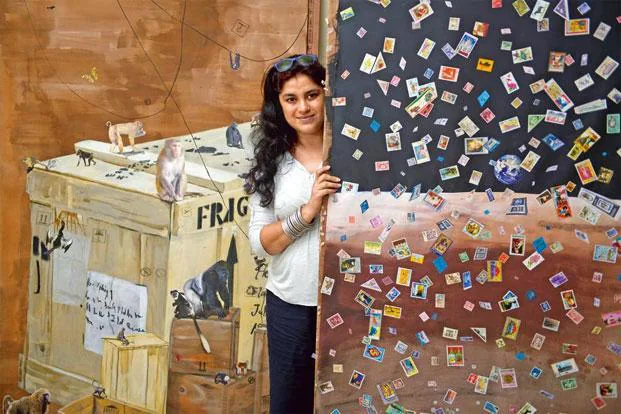
Emerging women artists in India are increasingly following a patterned movement towards metaphorical and fluid formats of self-portraiture, where the ‘self’ is represented through objects, absence, words, communities and experimentation, exploring the sides of vulnerability, self-image and body, gender identity and political placing as the key themes.
Self-portraiture is no more about showing faces and revealing identity but almost an anthropological and archaeological approach, where self can be reduced to or exaggerated into multitudes and possibilities of visuals and materials that speak of resistance and revival, conventions and breaking of notions, and containment within a gaze to breaking free from it.
These emerging voices highlight a shift from the literal likeness to a conceptual enquiry. They use self-portraiture to explore themes of mental health, domestic labour, and the intersectionality of caste and gender, proving that the medium is infinitely adaptable and evolving.
These emerging voices highlight a shift from the literal likeness to a conceptual enquiry. They use self-portraiture to explore themes of mental health, domestic labour, and the intersectionality of caste and gender, proving that the medium is infinitely adaptable and evolving. The core argument for the importance of self-portraiture lies in its ability to facilitate a ‘gender enquiry.’ When an Indian woman artist paints or photographs herself, she questions, ‘Who is allowed to look at me? How have I been taught to look at myself?’
In traditional Indian society, modesty (Lajja) often dictates that women remain the observed, not the observer. But our society and culture also hold histories of goddesses like Lajja-Gauri that defy the definition of lajja, almost positing the opposite of it, embarrassing and boldly stating the power of women. Self-portraiture is a direct violation of this modesty. It is an act of looking back. This ‘looking back’ is a powerful tool of confrontation. It forces the viewer to acknowledge the artist’s subjectivity. The mirror acts as a space for erasure for rebuilding and creating an image not as assigned but as imagined and aspired to by her. By documenting the scarred, defiant and divine body, these artists reject the pre-set standards and structures imposed by social, cultural, political and religious boxes. They provide a counter-narrative showing a self that is complex, angry, sexual, and evolving.
The journey of self-portraiture by women artists in India is a journey from silence to scream. From the early assertions of Amrita Sher-Gil to the experimental, digital-age enquiries of today’s emerging women practitioners of art, the act of depicting the self remains a vital form of resistance and confrontation. These artists use the mirror not to find a perfect image, but to find the truth of their own experiences. They confront the censorship of patriarchy, of tradition, and the pressures of modernity. In doing so, they transform the self-portrait into a universal mirror. As long as the female body remains a site of political and social contestation in India, the self-portrait will remain a necessary weapon. It is the visual manifesto of an ongoing dialogue of confrontation that refuses to surrender to the male gaze, societal expectations, gender roles, subaltern treatment and exclusions from the mainstream canons.