
Too much screen time in kids may look like autism: Doctors explain why – The Times of India


It usually starts quietly. A phone during meals. A cartoon to stop a meltdown. A screen handed over just to get through the day.And then, one day, something feels off.Your child doesn’t respond when you call their name. They stop making eye contact. Words they once used begin to fade. And the only thing that seems to hold their attention is a screen.
For many parents, this is where the fear sets in. Is it just a phase? Or could it be something more serious, like autism?Doctors say there’s a growing pattern they’re seeing in clinics, young children showing autism-like behaviours linked not to a neurodevelopmental condition, but to excessive screen exposure. It’s often referred to as “virtual autism,” and while the name sounds alarming, the story behind it is more complex—and, in many cases, reversible.
When autism-like signs aren’t autism
“‘Virtual autism’ is not a medical diagnosis but a term used to describe autism-like behaviours seen in young children with excessive screen exposure. The key difference is that these features are driven by environmental factors rather than underlying neurodevelopmental differences,” says Dr Hamza Hussain, Head of the Department of Psychiatry and Mental Health at Ruby Hall Clinic.That distinction matters. Autism spectrum disorder is a complex neurodevelopmental condition, often linked to genetic and biological factors. It is lifelong. But what doctors are now observing in some children is different.“What we often see is not a disorder in the classical sense, but a developmental slowdown,” Dr Hussain explains. “Children may appear withdrawn, have poor eye contact, or show limited interest in people, which can resemble features of autism but stem from reduced real-world stimulation.”And that phrase—reduced real-world stimulation—is at the heart of the issue.A studypublished in Cureus had a similar observation. “Screens are a critical issue in children’s neurodevelopment,” it said. “The children who are exposed to more screen time than other children showed symptoms of ASD-like difficulties in communication, delayed language skills, delayed cognitive and learning abilities, and inappropriate emotional reactions. Additionally, the exposure of children to screens at an early time in their life makes them at high risk of developing ASD than other children who are exposed later. This is because the first year of life is critical in children’s development, and they should be away from exposure to any screen,” it has concluded.
The missing ingredients of early development
Early childhood isn’t just about growing taller or learning new words. It’s when the brain is wiring itself at an incredible pace.“In early childhood, the brain develops through interaction, eye contact, language exchange, play, and emotional engagement,” says Dr Hussain. “When screen time replaces these experiences, children may show delays in speech, reduced social responsiveness, and limited attention span.”So what happens when a child spends long stretches passively watching a screen?
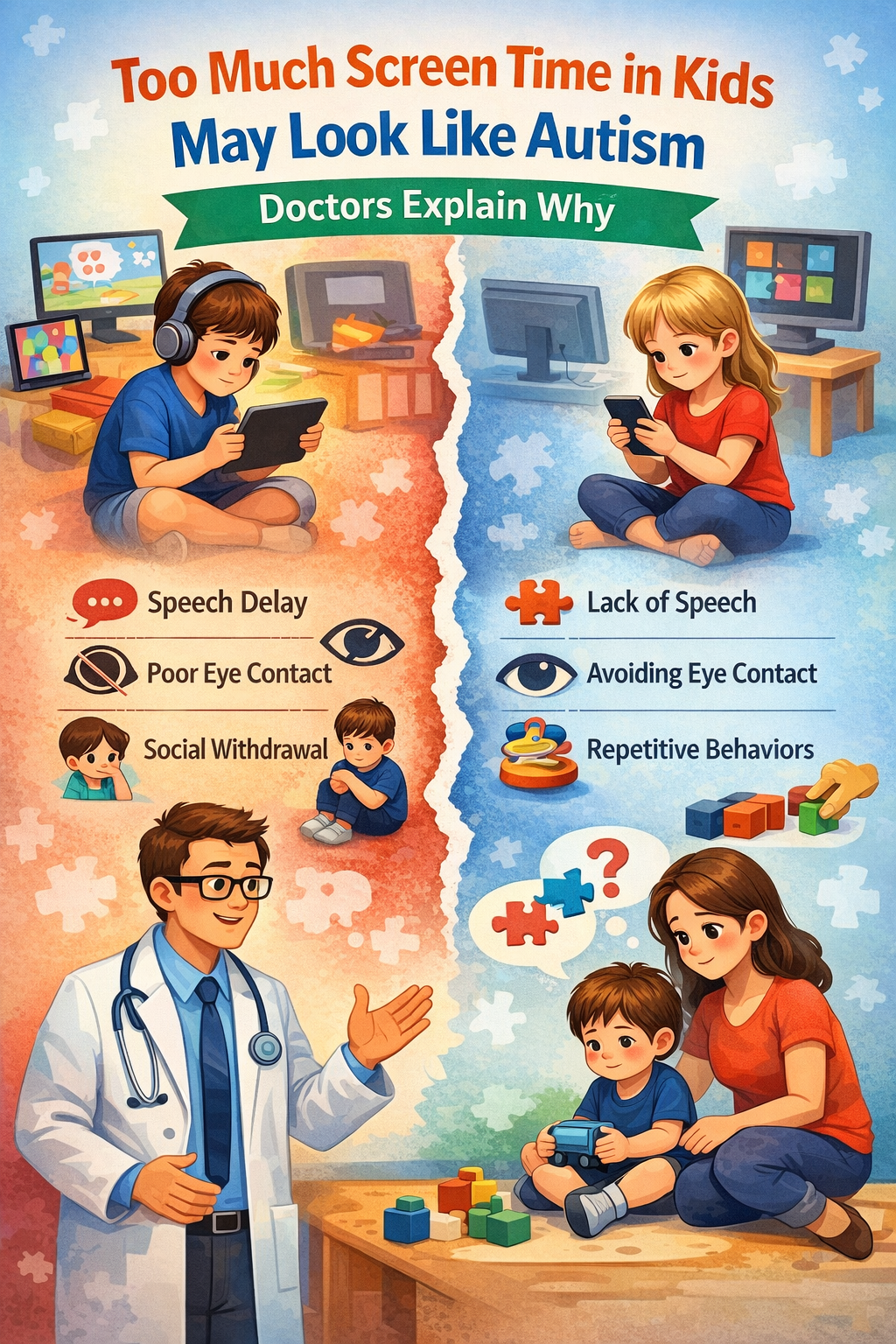
Image: AI
They’re not practicing back-and-forth conversation. They’re not learning to read facial expressions. They’re not pointing, reacting, or engaging. Over time, that gap begins to show.And sometimes, it shows in ways that alarm parents.
What doctors are seeing in clinics
Dr Zahabiya M Bagwala, paediatric infectious disease specialist at Saifee Hospital, Mumbai, has seen similar patterns.“Virtual autism is referred to as ‘autistic like behaviour’ in normal kids because of excessive time spent on the screen. The only difference is that it is reversible. When the time spent on the screen is stopped, the behavior changes,” she says.She draws a clear line between the two conditions.“Autism spectrum disorder is a neurodevelopmental disorder caused by genetic factors. It can also be caused by non-genetic factors. It is irreversible and progressive.”But excessive screen exposure can still disrupt how a child’s brain develops.“These areas of the brain control language development, language comprehension, and executive functions. This can lead to decreased concentration levels, language and speech delay, regression, and the development of ADHD and autism-like behavior,” Dr Bagwala explains.And then there’s sleep, something many parents don’t immediately connect to screens.“Blue light emitted by the screen can lead to decreased melatonin production, resulting in sleep deprivation. Sleep deprivation can lead to anxiety, irritability, and inattentiveness, which can lead to behavior disorder.”So it’s not just about what kids are watching. It’s also about what screens are quietly taking away—sleep, curiosity, and human interaction.
The early warning signs parents often miss
The tricky part is that the signs don’t always look dramatic at first. They creep in gradually.“Early warning signs include delayed speech, lack of response to name, reduced eye contact, irritability when screens are removed, and a preference for screens over human interaction,” says Dr Hussain.Dr Bagwala points to very specific behavioural changes that parents should watch for.“One of the early warning signs is the lack of response to their names, not answering the names, and not talking as the child used to talk,” she says.Sometimes, children who were picking up words suddenly stop.“A normal 1.5–2 year old talking, learning new words will stop learning new words and will not even talk to parents, family, or friends and will not even make eye contact with the people. The child will only be interested in the screen, and the tantrums cannot be controlled if the screen is not given.”There are subtler cues too. A child who no longer enjoys physical play. One who doesn’t try to share excitement with a parent. Or one who loses interest in pretend play—the kind where a spoon becomes an airplane or a doll becomes a patient.These moments may seem small. But together, they tell a story.
Why screens can become so addictive for young children
Screens are designed to hold attention. Bright colours, fast cuts, constant stimulation. For a young brain, it’s overwhelming—and addictive.“Excessive time spent on the screen can reduce the curiosity level in the child,” says Dr Bagwala. “Excessive time spent on the screen can lead to social isolation, which can cause the child to turn into a sedentary individual.”And once a child begins to rely on screens, for eating, calming down, or simply passing time, it becomes harder to pull back.That’s when parents find themselves stuck. The screen feels like the only thing that works.
The hopeful part: it can be reversed
Here’s where things take a more reassuring turn.“The encouraging aspect is that, unlike autism spectrum disorder, these changes can be partially or significantly reversible,” says Dr Hussain. “When screen exposure is reduced and replaced with interactive play, communication, and structured routines, many children show noticeable improvement over time.”Dr Bagwala echoes this.“Yes, virtual autism can be cured. The screen time can be reduced, and the child can be encouraged to play and have more social interactions. This will help in the development of the child. This can be accompanied by behavioral and speech therapy to ensure all-round development.”That word, reversible, is critical. It means early action can make a real difference.So how much screen time is too much?Guidelines from the Indian Academy of Pediatrics offer a simple framework, but real life is rarely that neat.For children under two, screens should ideally be avoided, except for video calls. For preschoolers, about an hour of supervised, high-quality content is considered acceptable. Older children can have more flexibility, as long as screens don’t interfere with sleep, school, or social interaction.But beyond numbers, doctors stress something more fundamental.“Safe screen use in early childhood should be minimal and supervised. More importantly, it should never replace conversation, play, or bonding,” says Dr Hussain. “Real-world interaction remains the most powerful driver of brain development.”And that’s really the heart of it.
Bringing back balance
This isn’t about demonising screens. They’re part of modern life, and they’re not going anywhere.But the balance has shifted too far for many children.“The focus should not be on screens alone, but on restoring balance ensuring that children engage more with people than with devices during their critical developmental years,” Dr Hussain says.That might mean messy play instead of a cartoon. A conversation instead of a video. A tantrum worked through, rather than silenced with a screen.It’s not always easy. But it’s often where the real growth happens.And sometimes, simply putting the phone away and getting down on the floor to play can change more than we think.Medical experts consulted This article includes expert inputs shared with TOI Health by: Dr Hamza Hussain, Head of the Department Psychiatry and Mental Health at Ruby Hall ClinicDr Zahabiya M Bagwala, paediatric infectious disease specialist at Saifee Hospital, MumbaiInputs were used to explain the damaging effect of screen exposure in kids and its correlation with autism.