
Strait Of Malacca China Vulnerability: Hormuz is a trailer. Malacca is China’s real nightmare — and India knows it – The Times of India
The Strait of Hormuz is at the centre of the US-Iran war, and the world is being reminded of a hard geopolitical truth: when a narrow waterway is threatened, the shock travels far beyond the battlefield.Tankers slow, insurers panic, freight costs jump, and energy markets convulse.
Reuters reported on Tuesday that the ongoing US-Iran war has pushed the Strait of Hormuz close to effective closure, with around 20 million barrels per day of oil and fuel supply disrupted, roughly a fifth of global seaborne energy trade.But if Hormuz is in an immediate crisis, the deeper strategic warning may lie thousands of kilometres to the east.Because for China, the real long-term maritime vulnerability is not in the Gulf. It is in Southeast Asia — at the Strait of Malacca, the narrow sea lane that connects the Indian Ocean to the Pacific and carries a huge share of East Asia’s energy and trade.And while India does not control Malacca, its geography gives it something almost as important in a crisis: proximity.From the Andaman and Nicobar Islands, India sits close enough to the western approaches of the strait to monitor, pressure, complicate and, in an extreme conflict, help deny access to one of the most important shipping corridors in the world.That is what makes China’s vulnerability an advantage for India, in a hypothetical but possible standoff with Beijing.As Dr Ashok Sharma, visiting fellow at the University of New South Wales Canberra at the Australian Defence Force Academy, put it, India’s real edge lies not in fully stopping maritime traffic but in “creating uncertainty and strategic pressure rather than fully stopping maritime traffic.”In short, Malacca is China’s Achilles’ heel.A Malacca-linked crisis would not emerge in a vacuum. It would most plausibly be triggered in a wider regional conflict, for instance, if China moves militarily on Taiwan and the Indo-Pacific theatre widens, or if a future India-China Himalayan standoff spills into the maritime domain.In either scenario, the Strait of Malacca would quickly become more than a shipping lane. It would become a strategic pressure point.
Why Hormuz is the perfect trailer for a Malacca crisis
The Hormuz shock is not just a Middle East issue. It is a live demonstration of how a chokepoint crisis unfolds in the modern world.The US Energy Information Administration (EIA) estimates that the Strait of Hormuz carried 20.9 million barrels per day in the first half of 2025, making it one of the world’s two most important energy chokepoints.And the latest Gulf conflict shows what happens when that artery is threatened: prices spike, governments scramble, and even major producers warn that emergency responses are inadequate.The lesson is straightforward. A chokepoint does not need to be physically sealed shut to cause economic pain.The fear of disruption is often enough. War-risk premiums rise. Ships reroute. Delivery windows slip. Markets react before missiles do.That is precisely why Beijing has spent years worrying about Malacca.If Hormuz is the world’s oil panic button, Malacca is China’s long-standing strategic nightmare.
China’s ‘Malacca Dilemma’
The Strait of Malacca is not just a busy shipping lane. It is the most critical maritime artery in Asia.According to the latest EIA World Oil Transit Chokepoints analysis, the Strait of Malacca carried 23.2 million barrels per day of oil in the first half of 2025, accounting for 29% of total global maritime oil flows.That makes it the largest oil chokepoint in the world by volume, even bigger than Hormuz.
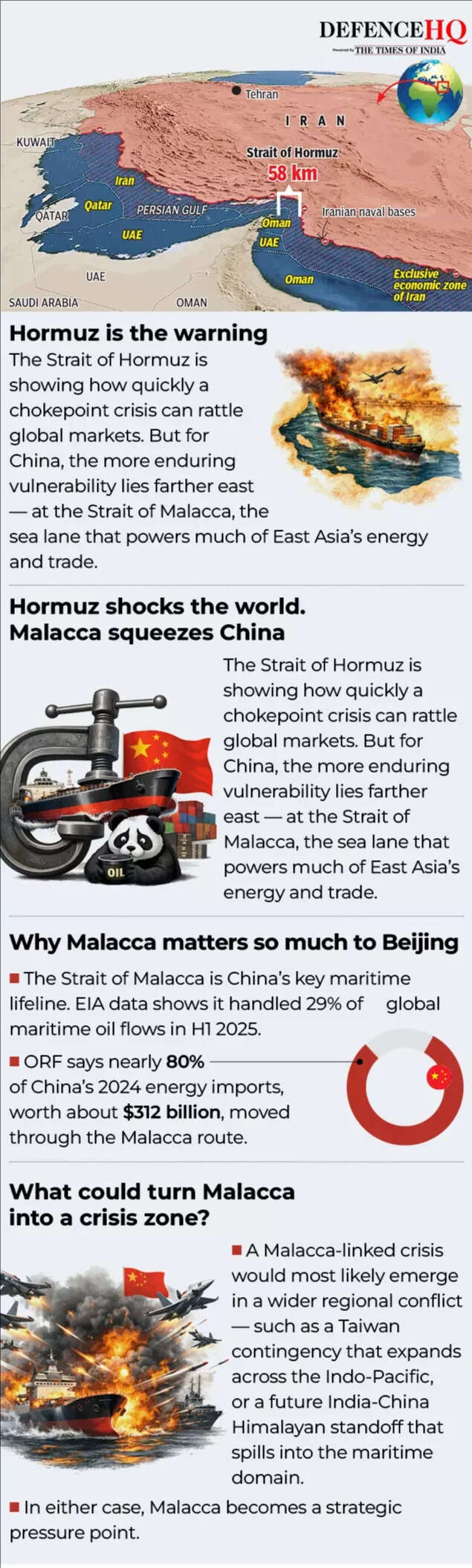
The same EIA report says around 9.2 billion cubic feet per day of LNG also flowed through the strait in the same period.According to think tank ORF, China’s energy imports reached US$390 billion in 2024, with nearly 80 per cent, amounting to US$312 billion, transported through the Malacca Strait.That scale matters enormously for China.Malacca is the shortest and most efficient sea route linking Middle Eastern oil and gas suppliers to East Asia. For China — the world’s largest manufacturing economy and one of the biggest energy importers — it is a lifeline.Oil, LNG, raw materials, intermediate goods and containerised trade all depend heavily on uninterrupted access through this corridor.This is the famous “Malacca Dilemma”: China’s fear that too much of its economy still depends on a narrow sea lane it does not control.Beijing has spent years trying to reduce this risk. It has worked on Belt and Road Initiative (BRI) with other countries, built pipelines, expanded overland corridors, invested in ports, and tried to diversify routes through what critics often call the “String of Pearls” strategy.But diversification is not a replacement. None of these alternatives can fully replicate the scale, speed and cost-efficiency of the Malacca route.That is the core vulnerability.
A dangerous chokepoint
Malacca’s strategic power lies not just in volume, but in geometry.The strait is a narrow, heavily trafficked maritime corridor running between Indonesia, Malaysia and Singapore. At its southern end, the navigable channel tightens sharply, creating natural congestion and amplifying risk.The EIA describes it as the shortest sea route between Middle Eastern suppliers and East Asian markets, which is exactly why so much traffic is forced through it.This is why Malacca is so hard to replace in a crisis. Ships can technically divert via the Sunda Strait or Lombok Strait, and the EIA explicitly notes these as alternative routes. But they are longer, less efficient, and more expensive. That means more sailing time, higher fuel burn, costlier insurance and disrupted supply schedules.Sharma noted that the Lombok and Sunda Straits are longer, costlier and less efficient for large-scale commercial and energy shipping, meaning they may reduce China’s exposure but do not eliminate the underlying vulnerability.For a country like China, whose export machine depends on predictable delivery cycles and affordable energy, that is not a minor inconvenience. It is a structural threat.
The Andaman and Nicobar advantage
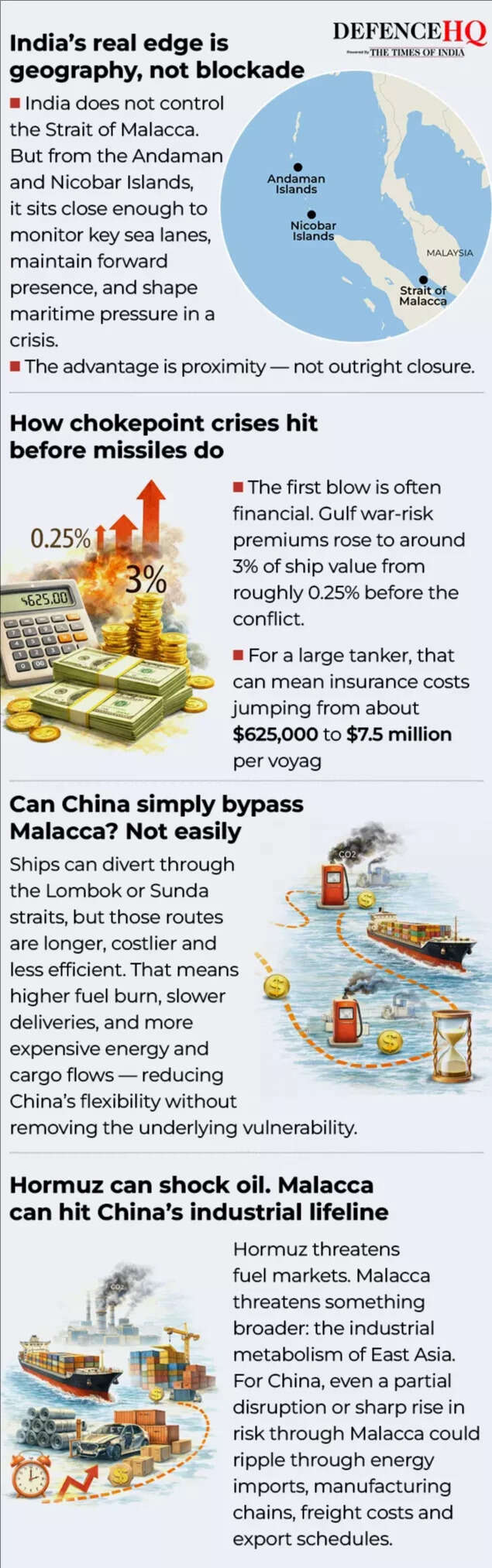
This is where India’s role in this part of the world becomes genuinely powerful.Its greatest advantage in any Malacca-linked crisis is not just naval strength. It is geography.The Andaman and Nicobar Islands sit deep in the eastern Indian Ocean, close enough to the western approaches of Malacca to make them strategically invaluable.The Strait of Malacca is less than a day’s steaming from Port Blair, a fact that captures the entire strategic importance of these islands.This is what makes the Andaman and Nicobar chain India’s closest equivalent to an “unsinkable aircraft carrier.”Unlike a carrier battle group, islands do not need to be deployed. They are already in place. They cannot be sunk. They can host aircraft, surveillance systems, missiles, drones, logistics nodes and naval detachments. And in a maritime crisis, that permanence matters.At the southern tip, the symbolism becomes even sharper. INS Baaz, India’s southernmost military air station at Campbell Bay, sits near a strategically vital corridor and gives India a forward operating position near the Six Degree Channel and close to the western approaches to the wider Malacca-bound sea lanes.Sharma also said the Andaman and Nicobar Islands are of major strategic importance because of their proximity to the western entrance of Malacca, with installations such as INS Baaz strengthening India’s ability to monitor key sea lanes, deploy air and naval assets, and sustain a forward presence in a crisis.That matters because, unlike China, India does not need to “arrive” at Malacca from far away. It is already sitting near the gateway.This is the biggest contrast with extra-regional powers. The US can project power into the region. India lives in the region.That distinction is central to India’s advantage. Sharma noted that while extra-regional powers such as the United States may possess greater overall naval power, India benefits from proximity, shorter logistics lines and the ability to sustain surveillance in the eastern Indian Ocean over time.
The real power is not closure
India cannot unilaterally shut the Strait of Malacca.Sharma also cautioned that “blockade” is too strong a term in most realistic scenarios because it implies a declared wartime act with serious legal and military consequences.In his view, “sea denial”, “maritime surveillance”, and “interdiction capability” are more accurate ways to describe India’s likely posture.Any such move would be legally explosive, diplomatically costly and militarily escalatory, especially since the strait is bordered by Indonesia, Malaysia and Singapore.However, in a real crisis, the most important question is not whether a navy can slam the gate shut. It is whether it can make the route unsafe, uncertain or uneconomical, exactly what we are observing in the case of Hormuz during the Iran conflict.And that is where India’s posture in the Andaman Islands becomes significant.From these islands, India can expand maritime domain awareness, deploy P-8I surveillance aircraft, operate drones, increase submarine and surface patrols, and create an environment in which every tanker or container ship passing toward East Asia knows it is being watched.
In a higher-end conflict, land-based anti-ship systems and air assets could support a broader sea-denial strategy.This is where the concept of A2/AD — anti-access/area denial — becomes useful. India does not need to conquer sea space. It only needs to make adversarial access costly and risky.And that brings us to the most underrated weapon in a chokepoint crisis – insurance.
Business shock for China
A Malacca crisis would not begin with missiles. It would begin with spreadsheets.The most immediate economic damage in a chokepoint crisis often comes from war-risk insurance, not direct military strikes.And the current Hormuz crisis offers a live example. On March 6, war-risk premiums for vessels in the Gulf had jumped to around 3% of a ship’s value, up from roughly 0.25% before the conflict, reported Reuters.For large tankers valued between $200 million and $300 million, that translates into roughly $7.5 million per voyage, compared with about $625,000 earlier.In the days before that, premiums rose to 1% from about 0.2% in just 48 hours as the Iran conflict widened.If an area is declared unstable or becomes a conflict zone, underwriters can sharply raise premiums for ships transiting it.Some operators may avoid the route altogether. Others may demand higher freight rates or reroute through longer alternatives.According to the EIA’s chokepoint analysis, the disruption of major transit routes leads to supply delays and higher shipping costs, even when alternatives exist.For China, that would matter at multiple levels: energy imports would become costlier and slower, factory input timelines less reliable, export delivery schedules more vulnerable, freight and charter costs higher, and working capital pressures sharper across manufacturing supply chains.In other words, Malacca is not just an oil story. It is a factory floor story.If Hormuz threatens fuel markets, Malacca threatens the industrial metabolism of East Asia — and China most of all.
Great Nicobar Project: India’s future strategic-business node
One of the most promising aspects of India’s strategic advantage in the region is the Great Nicobar Island, situated at the southernmost part of the Andaman archipelago.The Indian government is planning the ‘Great Nicobar Project’ there.The Great Nicobar Project is a massive infrastructure development initiative with an estimated budget ranging from Rs 75,000 crore to Rs 92,000 crore.India’s ambitious plans for the island include a major International Container Transhipment Terminal (ICTT) at Galathea Bay, along with wider infrastructure and connectivity upgrades.This matters because it is not just a domestic development project. It is part of a larger maritime imagination.If fully built out, it could strengthen India’s presence at the mouth of one of the world’s busiest sea systems.It would not magically make India “the new Singapore” overnight but it would push India further into the business of regional shipping, transhipment, and maritime leverage.In simple terms, New Delhi is not just thinking like a continental power anymore. It is increasingly enhancing its capabilities to become a major maritime power.
The wider map
India’s leverage around Malacca is not limited to its own islands.In 2018, India and Indonesia agreed to cooperate around Sabang, a strategically located port near the western entrance to the Strait of Malacca.The symbolism was obvious: India was signalling interest not only in defending its waters, but in shaping the broader maritime geometry around one of Asia’s most critical sea lanes.Then there is the Malabar exercise, involving India, the US, Japan and Australia. This does not mean the Quad is some formal blockade alliance — it is not. But it does mean Beijing must account for an Indo-Pacific environment in which multiple capable navies are increasingly interoperable and strategically aligned.That matters because a chokepoint is never just about the water. It is about who can see it, who can reach it, and who can make its use uncertain.
The bigger picture
The real story around Malacca is not war fantasy. It is a dependency.Hormuz is showing the world what happens when a global system leans too heavily on a narrow channel. Malacca reveals the same vulnerability at a different scale, one tied not just to oil prices, but to the economic bloodstream of Asia.For China, the Strait of Malacca remains more than a shipping lane. It is a strategic dependence that no amount of rhetoric has fully solved.For India, the Andaman and Nicobar chain remains more than a distant island territory. It is a geographic gift that gives New Delhi proximity, surveillance reach and latent leverage over one of the world’s most important maritime corridors.The question in a future crisis is not whether India can literally padlock Malacca. That is too simplistic.The real question is more unsettling for Beijing: Can China afford even a partial disruption, even a temporary slowdown, or even a sharp rise in risk along the one sea route it still cannot ignore?That is the real lesson of Hormuz.And that is why, when the world talks about one chokepoint in the Gulf, we should also be looking east, toward the strait that may matter even more.