
From Nazi’s V-2 terror to India’s Agni precision: How rocket have reshaped global warfare – The Times of India
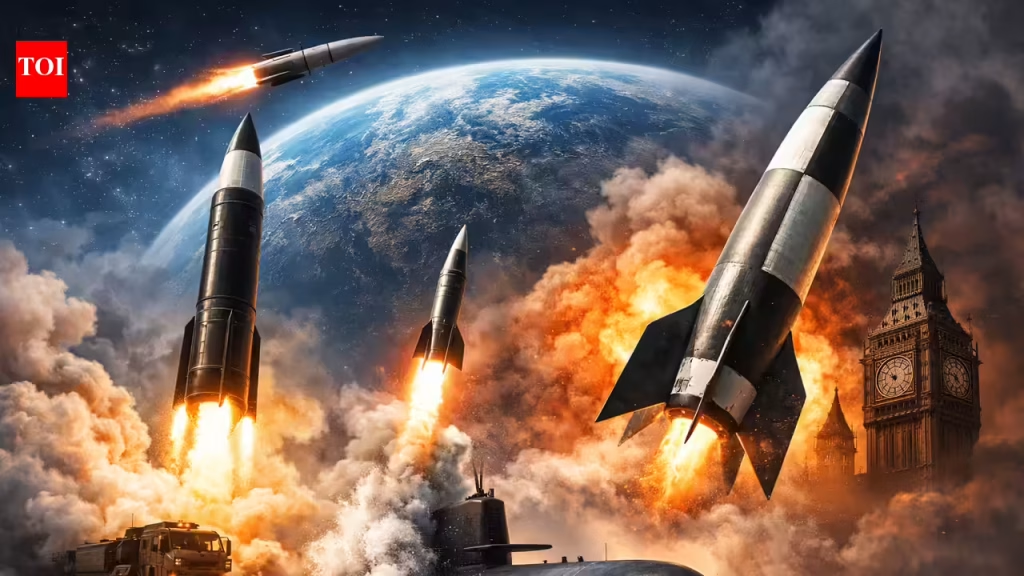
Late in the Second World War, residents of London reported hearing a strange silence before destruction. Unlike conventional bombers that could be heard approaching from miles away, these attacks arrived without warning. There was no aircraft overhead, no sound of engines, only a sudden explosion. What had struck the city was a revolutionary weapon: a rocket travelling faster than sound, following a high arc through the atmosphere before plunging towards its target.That weapon was the beginning of a new era in military technology. Ballistic missiles transformed warfare by making distance almost irrelevant. A weapon launched thousands of kilometres away could reach its target in minutes. Over the decades, these missiles evolved from experimental wartime rockets to the backbone of modern strategic deterrence. Today, ballistic missiles form one of the most critical components of global military power, shaping geopolitics, nuclear strategy, and national defence doctrines across continents.Understanding ballistic missiles is therefore essential to understanding the modern security environment. From their origins in wartime Germany to their central role in India’s strategic deterrence, ballistic missiles have become one of the most powerful technological instruments ever developed.
What is a ballistic missile
A ballistic missile is a rocket-powered weapon designed to deliver a payload to a distant target by following a ballistic trajectory. Unlike cruise missiles, which fly continuously under engine power and aerodynamic control, ballistic missiles are powered only during the initial phase of flight. Once the rocket fuel is exhausted, the missile follows a free-fall path determined by gravity and momentum, much like an artillery shell travelling over long distances.These missiles are primarily designed to deliver warheads with high speed and precision. The payload carried by a ballistic missile can vary widely depending on the mission and the capabilities of the country operating it. Warheads may contain conventional explosives, nuclear devices, or in some cases chemical or biological agents. In modern strategic arsenals, ballistic missiles are most commonly associated with nuclear deterrence.
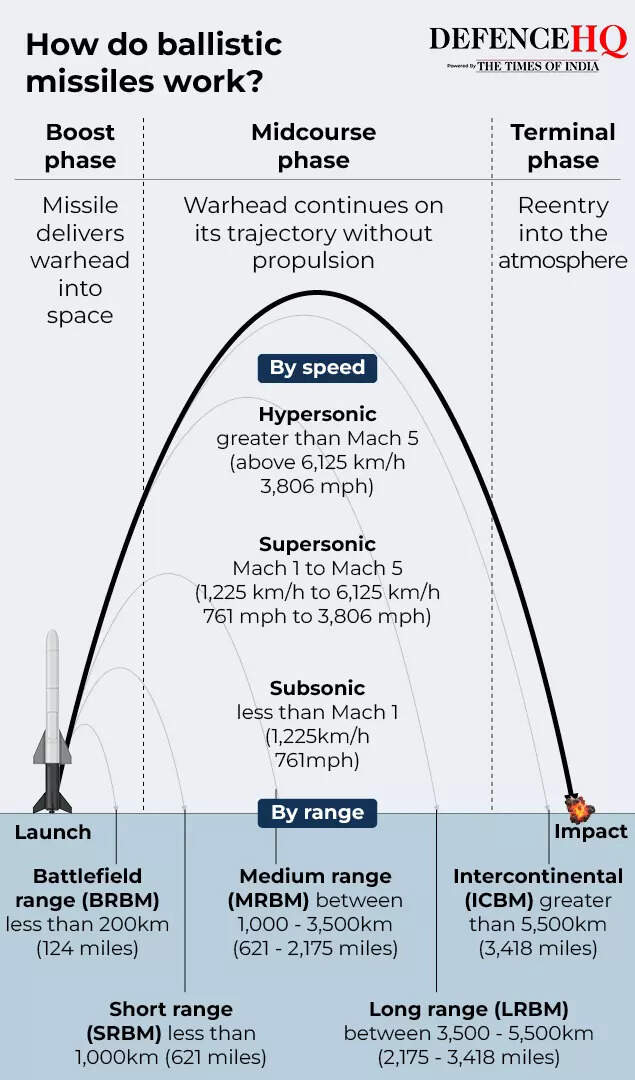
Ballistic missiles are classified mainly by their range. Tactical ballistic missiles have ranges below 300 kilometres and are used on the battlefield. Short-range ballistic missiles can strike targets up to roughly 1,000 kilometres away. Medium-range and intermediate-range missiles extend that reach to several thousand kilometres. At the top of the hierarchy are intercontinental ballistic missiles, or ICBMs, capable of travelling more than 5,500 kilometres and striking targets across continents.Launch platforms also vary. Some ballistic missiles are launched from underground silos or mobile launch vehicles on land, while others are deployed aboard submarines. Submarine-launched ballistic missiles provide stealth and survivability, making them a key component of nuclear deterrence strategies.
History of ballistic missiles
The history of ballistic missiles is closely linked to the evolution of modern warfare, rocket science, and nuclear strategy. What began as an experimental wartime technology eventually developed into one of the most powerful strategic weapons systems in the world. Over time, ballistic missiles evolved from relatively crude rockets with limited accuracy into highly sophisticated systems capable of delivering multiple warheads across continents within minutes.The modern ballistic missile era began during the Second World War with Nazi Germany’s V-2 rocket programme. Developed under the leadership of German engineer Wernher von Braun, the V-2 was the world’s first operational long-range guided ballistic missile. Powered by a liquid-fuel rocket engine, it could travel over 300 kilometres and strike targets at supersonic speeds.Germany began deploying the V-2 in 1944 against Allied cities, particularly London and Antwerp. Unlike conventional bombers, the missile followed a ballistic trajectory and travelled faster than sound, making interception virtually impossible with the air defence systems of that time. Although it did not change the outcome of the war, the V-2 demonstrated the strategic potential of long-range rocket weapons.After World War II, both the United States and the Soviet Union recognised the military importance of rocket technology. Through programmes such as Operation Paperclip, the United States transferred German scientists, including Wernher von Braun, to work on American missile and space projects. The Soviet Union also captured German equipment and expertise, with rocket designer Sergei Korolev leading efforts to build advanced missile systems based on V-2 technology.Ballistic missile development accelerated during the Cold War as the United States and the Soviet Union competed to develop long-range nuclear delivery systems. In 1957 the Soviet Union successfully tested the R-7 Semyorka, the world’s first intercontinental ballistic missile capable of striking targets thousands of kilometres away. The same rocket also launched Sputnik, the first artificial satellite.The United States soon followed with its own ICBM programmes, including the Atlas and Titan missiles. By the late 1950s both superpowers possessed missiles capable of delivering nuclear warheads across continents within minutes, fundamentally transforming global military strategy.Over time, ballistic missile technology advanced significantly with improvements in propulsion, guidance systems, and warhead design. Innovations such as solid-fuel engines and multiple independently targetable re-entry vehicles allowed a single missile to carry several warheads aimed at different targets.Even after the Cold War, ballistic missile technology continued to spread to other nations including China, India, and North Korea. Today, ballistic missiles remain central to nuclear deterrence strategies and continue to evolve with emerging technologies such as hypersonic glide vehicles and advanced missile defence systems.
How a ballistic missile works
A ballistic missile operates through a sequence of distinct flight phases. The first phase is the boost phase, during which the missile’s rocket engines ignite and propel it upward. This stage typically lasts a few minutes and determines the missile’s trajectory and range. Once the fuel is exhausted, the rocket booster separates from the rest of the missile.After the boost phase, the missile enters the midcourse phase. During this stage the missile travels through space along an elliptical trajectory determined by the speed and angle achieved during launch. For long-range missiles, this phase can occur hundreds or even thousands of kilometres above the Earth’s surface.The payload section, often called the “bus,” carries the warheads and guidance systems. In modern missiles the bus can release multiple warheads or decoys designed to confuse enemy missile defence systems. Each warhead then follows its own path toward the designated target.The final stage is the terminal phase. As the warhead re-enters the atmosphere, it experiences extreme heat caused by air compression. Special heat shields protect the warhead during this descent. Travelling at hypersonic speeds, the warhead then strikes its target or detonates above it.This combination of speed, altitude, and trajectory makes ballistic missiles extremely difficult to intercept, which is why they are considered one of the most formidable strategic weapons.
India and its ballistic missile capabilities
India began developing ballistic missile technology in the 1980s as part of a broader effort to build an indigenous defence capability. The Integrated Guided Missile Development Programme, launched in 1983 under the leadership of defence scientist A. P. J. Abdul Kalam, laid the foundation for India’s missile arsenal.One of the earliest systems developed under this programme was the Prithvi missile, a short-range ballistic missile designed for tactical battlefield use. Over time India expanded its missile programme to include longer-range systems capable of strategic deterrence.The Agni series of missiles became the backbone of India’s ballistic missile capability. Agni-I and Agni-II provide short and medium range strike capability, while Agni-III and Agni-IV extend India’s reach deeper into Asia. The Agni-V missile, with a range exceeding 5,000 kilometres, places India among the countries possessing intercontinental-range missile capability.India has also developed submarine-launched ballistic missiles such as the K-4 and K-15, deployed aboard nuclear-powered submarines. These systems form the sea-based leg of India’s nuclear triad, ensuring the survivability of its deterrent forces even in the event of a first strike.
How India mastered the art of ballistic missiles
India’s journey towards mastering ballistic missile technology is considered one of the most significant achievements in its defence and scientific development. Over the past four decades, the country has moved from being largely dependent on foreign technology to becoming capable of designing, testing, and deploying a wide range of indigenous ballistic missiles. This transformation was driven by strategic necessity, sustained investment in domestic research, and the creation of strong defence research institutions.India’s organised missile development effort began in 1983 with the launch of the Integrated Guided Missile Development Programme (IGMDP). Led by the Defence Research and Development Organisation (DRDO) under the leadership of aerospace scientist A. P. J. Abdul Kalam, the programme aimed to build a family of indigenous missile systems suited to India’s defence needs.The IGMDP focused simultaneously on multiple missile systems, including the Prithvi surface-to-surface missile and the Agni series of ballistic missiles. The programme helped India develop crucial technologies such as propulsion systems, guidance mechanisms, re-entry vehicles, and launch platforms within the country.International sanctions and restrictions on technology transfer pushed India to rely heavily on domestic research and innovation. Indian scientists gradually developed expertise in key areas such as solid rocket propulsion, inertial navigation systems, composite materials, and heat-resistant re-entry shields. These technologies are essential for long-range ballistic missiles that must withstand extreme temperatures during atmospheric re-entry.Progress in computing and guidance systems also improved the accuracy and reliability of India’s missile platforms.The Agni missile series became the backbone of India’s strategic missile capability. Initially developed as a technology demonstrator in the late 1980s, the programme evolved into a family of missiles with increasing range and sophistication.Agni-I and Agni-II strengthened India’s short- and medium-range strike capabilities, while Agni-III and Agni-IV significantly expanded operational range and technological complexity. The development of Agni-V marked a major milestone, providing India with intercontinental-range capability exceeding 5,000 kilometres and placing it among a select group of nations possessing long-range ballistic missiles.India’s ballistic missile programme also includes submarine-launched systems such as the K-15 and K-4 missiles, deployed on nuclear-powered submarines. These systems form the sea-based component of India’s nuclear triad, ensuring a survivable second-strike capability.Advancements such as canisterised missiles and mobile launch platforms have further improved readiness and survivability. Through decades of sustained research and development, India has built a robust ballistic missile programme that now forms a key pillar of its strategic deterrence and national security.
Ballistic missiles and the world’s military powers
Ballistic missiles remain one of the central pillars of global military power. A small group of countries possess the technological and industrial capacity required to develop and deploy long-range missile systems.The United States and Russia maintain the largest and most sophisticated arsenals of intercontinental ballistic missiles. These missiles form the backbone of their nuclear deterrence strategies, supported by submarine-launched missiles and strategic bombers.China has rapidly expanded its missile capabilities in recent decades, deploying both road-mobile and silo-based missiles. Countries such as France and the United Kingdom maintain smaller but highly advanced missile forces primarily deployed on nuclear submarines.India has emerged as one of the few countries with indigenous ICBM-class missile capability, while North Korea has also demonstrated long-range missile technology through a series of high-profile tests. Israel is widely believed to possess long-range ballistic missiles as part of its strategic deterrence.These missile systems serve not only as weapons but also as instruments of geopolitical influence, shaping the strategic balance between major powers.
World’s top air defence systems
As ballistic missile technology advanced, nations began developing sophisticated systems to intercept incoming missiles. These air and missile defence systems integrate radar networks, interceptor missiles, and command centres capable of tracking and destroying threats in real time.Russia’s S-400 and the newer S-500 systems are among the most advanced long-range air defence platforms currently in operation. They are designed to intercept aircraft, cruise missiles, and certain types of ballistic missiles.The United States operates several layered missile defence systems, including the Patriot PAC-3 and the Terminal High Altitude Area Defense system. These platforms are deployed in several regions to protect military installations and allied nations.Israel has developed one of the most sophisticated multi-layered air defence networks in the world. Systems such as Iron Dome, David’s Sling, and Arrow provide protection against rockets, cruise missiles, and ballistic missiles.Other countries have also invested heavily in air defence technology. Europe’s SAMP/T system and China’s HQ-9 missile defence platform represent significant capabilities designed to counter aerial threats.
How lethal is an intercontinental ballistic missile
Intercontinental ballistic missiles represent the most destructive weapons ever deployed by human civilisation. These missiles can travel thousands of kilometres at speeds exceeding several kilometres per second. A single missile can carry multiple nuclear warheads, each capable of striking a separate target.Modern ICBMs equipped with MIRV technology can release several independently guided warheads during flight. This capability allows one missile to attack multiple cities or military bases simultaneously.The destructive potential of such weapons is enormous. Nuclear warheads carried by ICBMs can produce explosions far more powerful than the bombs used during the Second World War. The combination of speed, range, and payload makes ICBMs extremely difficult to defend against.Because of this destructive capability, ICBMs are primarily used as deterrent weapons rather than battlefield tools. Their purpose is to prevent war by ensuring that any nuclear attack would result in devastating retaliation.
Why the United States is not considered a market leader in missile exports
Despite possessing some of the most advanced missile technologies in the world, the United States is not considered a dominant player in the global ballistic missile export market. This situation is largely the result of strict international arms control regimes, domestic export policies, and the strategic nature of missile technology itself.One of the main reasons is the United States’ commitment to non-proliferation agreements aimed at preventing the spread of weapons capable of delivering weapons of mass destruction. Washington is a founding member of the Missile Technology Control Regime (MTCR), an international arrangement established in 1987 to limit the proliferation of missile systems capable of carrying a payload of at least 500 kilograms to a range of more than 300 kilometres. Under MTCR guidelines, member states agree to exercise strong restraint in exporting such systems or the technology required to build them. As a result, the United States places strict controls on the export of ballistic missile technology.American defence export policy also prioritises stability and strategic alliances over commercial sales. Instead of exporting ballistic missiles, the United States focuses more on supplying defensive systems such as surface-to-air missiles, missile defence interceptors, and advanced aerospace platforms. Systems such as Patriot air defence missiles, THAAD interceptors, and naval missile defence technologies are widely exported to allied countries, while offensive ballistic missile systems remain tightly controlled.Another factor is the sensitive nature of ballistic missiles as nuclear delivery platforms. Many of the most advanced US missiles were developed specifically for nuclear deterrence and form a core part of the country’s strategic arsenal. Exporting such systems could risk destabilising regional security balances and undermine global non-proliferation efforts.In contrast, some countries have been more willing to export missile technologies or related systems, often for geopolitical influence or defence partnerships. These transfers, sometimes involving short- or medium-range missile technology, have contributed to the perception that the global missile export market is dominated by suppliers outside the United States.For these reasons, the United States remains a technological leader in missile development but not a commercial leader in missile exports. Its approach emphasises strict control of strategic weapons while focusing international defence sales on protective and defensive military systems.
The future of ballistic missile technology
Ballistic missile technology continues to evolve as nations invest in new forms of strategic weapons. Advances in propulsion, materials science, and navigation systems are making missiles faster, more accurate, and more difficult to intercept.One of the most significant developments in recent years is the emergence of hypersonic glide vehicles. These weapons can travel at extremely high speeds while manoeuvring unpredictably during flight, potentially bypassing traditional missile defence systems.Another trend is the development of more survivable launch platforms, including mobile launchers and stealthy submarine systems. These technologies ensure that missile forces remain operational even during conflict.As geopolitical tensions persist and technological competition intensifies, ballistic missiles will likely remain a central element of military strategy for decades to come.