
Accused Review: How The Film Wastes Konkona Sen Sharma’s Brilliance
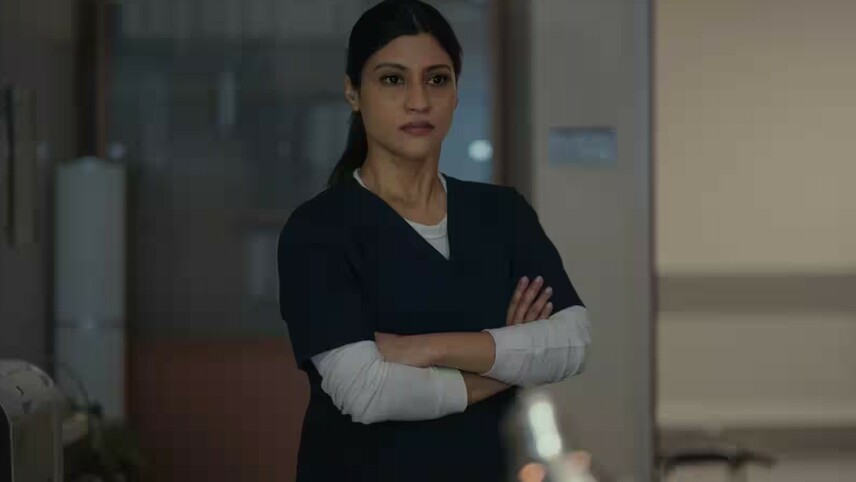
Joining the list of Indian crime thrillers with intriguing one-word titles — and a one-dimensional story — is Anubhuti Kashyap’s newest Netflix production, Accused. The film follows the story of a celebrated gynaecologist, Dr Geetika (played by Konkana Sen Sharma), who finds herself in the kind of trouble she could never have imagined when the hospital she works at begins receiving a series of anonymous emails accusing her of sexual misconduct.
A story that quickly falls flat
Caught in a storm of lies and accusations, Geetika is forced to watch as her simple, but fulfilling life begins to fall apart right in front of her eyes. Overnight, Geetika goes from having a loving wife, a baby on the way, a huge promotion that would skyrocket her career, and a large mansion in London, to no job, no wife, and no baby. Accused of being a sexual predator, first over private emails and later all over social media, her friends and family can no longer tell whether she is guilty or not. Geetika is left on her own to clear her name, as unresolved marital tensions, workplace rivalries, and her past continue to complicate matters.
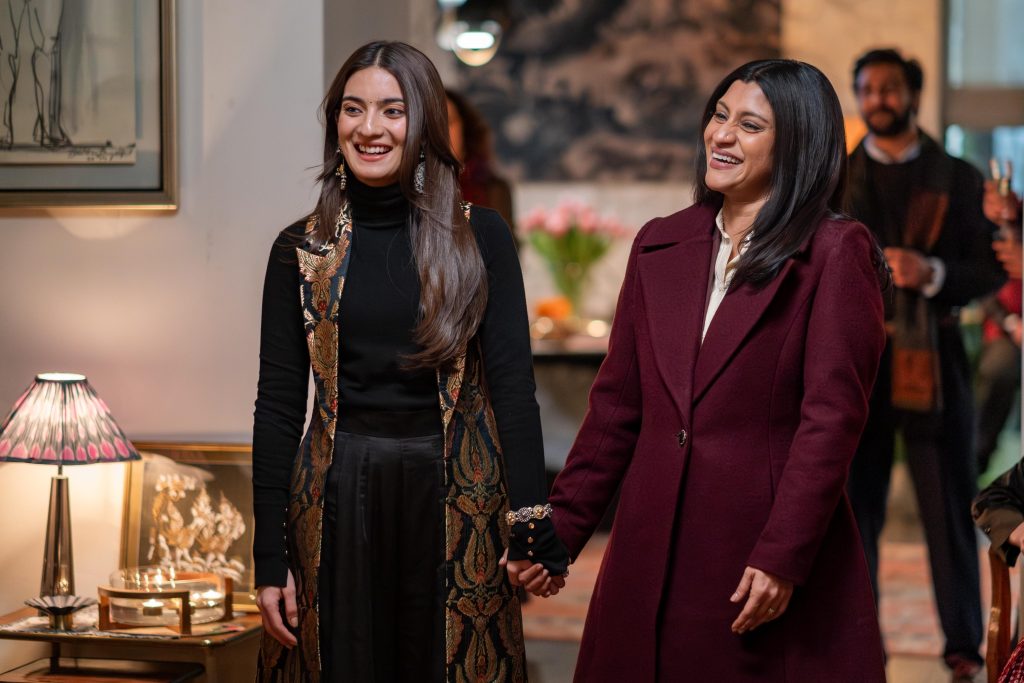
Accused is Anubhuti Kashyap’s second directorial venture, after directing Ayushmann Khurrana in the social comedy Doctor G. This time, with a bigger budget and more star power, she moves her story to London, and the film’s tone aptly adapts to the gloom of the setting. Given the film’s interesting premise, coupled with the fact that Netflix is one of the main producers and Konkana Sen Sharma is in the lead, there is little to warn the audience of just how flat the narrative could run.
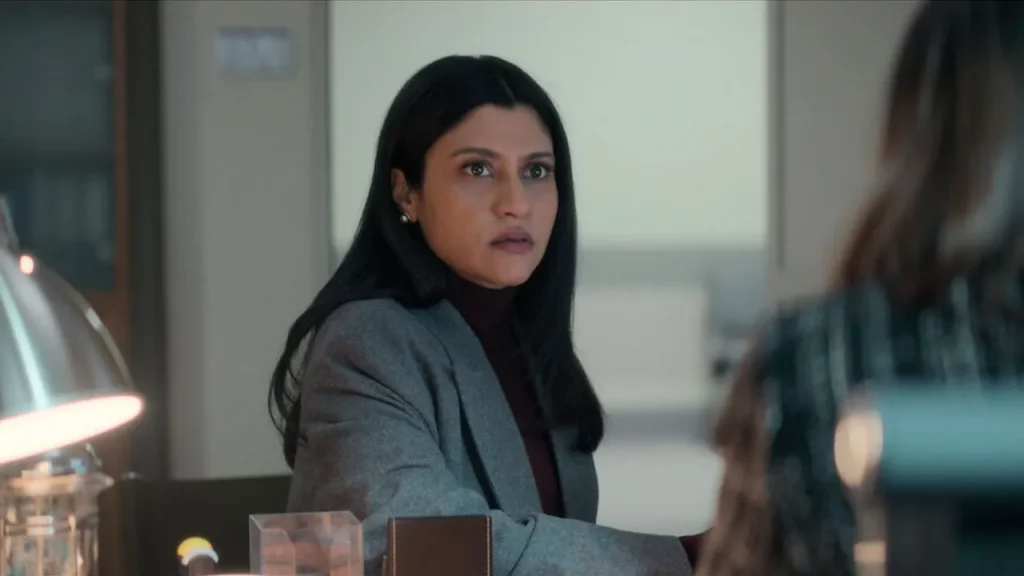
Being the experienced artist that she is, Sen Sharma is able to bring a certain gravitas to her character: a terse and ambitious female surgeon in the world of a male-dominated industry.
Being the experienced artist that she is, Sen Sharma is able to bring a certain gravitas to her character: a terse and ambitious female surgeon in the world of a male-dominated industry. She represents her character’s sexuality with subtle shifts of body language and nuanced microexpressions, and doesn’t make the whole character revolve just around her sexual identity.
A one-dimensional script with caricaturised characters
But there is only so much a single actor can do to bring nuance to a one-dimensional script. With a queer love story at the heart of its narrative, there fails to be much chemistry between the leads. Instead, there is a certain awkwardness between Geetika and her wife from the beginning, which fails to convince the audience of their happy marriage. The lack of chemistry between them also makes the casting choice stand out. One can see clearly how Sen Sharma is typecast in a role similar to the one she played in Geeli Pucchi, Neeraj Ghaywan’s short for the Netflix anthology Ajeeb Daastaans (2021).
However, the arc that Sen Sharma’s character charts out is conceptually interesting, and delves into the difference between abuse of power and sexual abuse, and bravely probes questions about whether they might share anything in common with respect to violating an individual’s boundaries. Braver still, the film veers into discussions about the slippery relationship between power, sex, and desire while maintaining gender politics at the forefront.
Dr Geetika has built her reputation as someone who allows no room for error and is harsh and critical of her fellow employees at the first indication that something has gone wrong. On the one hand, her severe stance is easy to justify, given the delicate nature of her job, where even a small mistake could result in someone losing their life. But on the other hand, Geetika herself acknowledges how the competitive nature of her field, coupled with her socially disadvantaged position as a queer woman, forces her to be harsher than necessary.
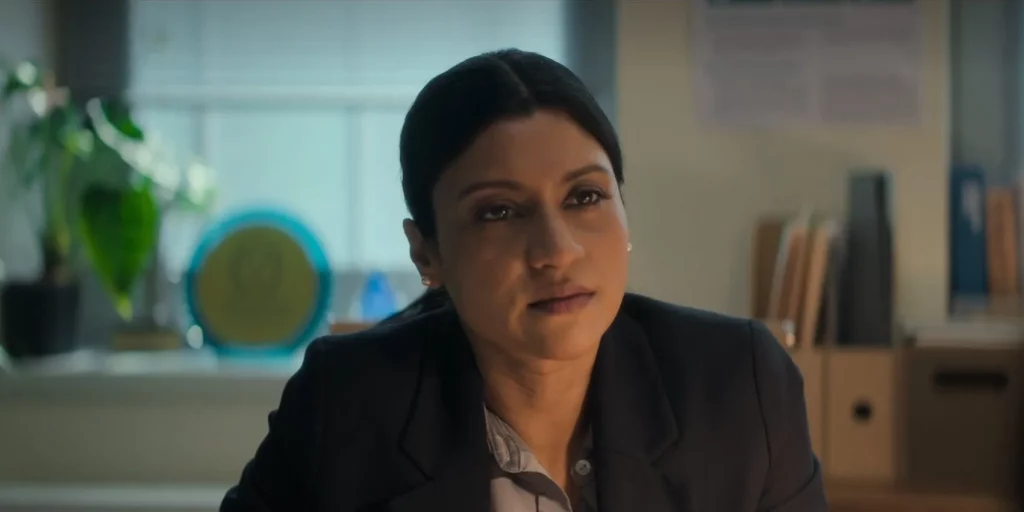
While all of these are intelligent questions to pose to the audience, the film fails to flesh out the nuances it sets itself up to address. And the reason for this is apparent. As a highly ambitious film looking to explore the consequences of blind ambition itself, Accused falls prey to the classic conundrum of quantity over quality.
Trying to address sexuality, gender dynamics, power play, workplace tensions, and the politics of the #MeToo movement simultaneously, the film fails to do justice to any of the myriad social questions it takes on, let alone treat them with intersectional sensitivity. In trying to do so much at the same time, Anubhuti Kashyap’s latest ends up doing far too little, with each of its central ideas either left underdeveloped or contradicting others.
Right from the outset, Accused begins to fall apart, quickly giving way to melodrama and cheesy crime thriller tropes like the quirky private investigator constantly smoking an invisible cigarette, or the male best friend who is secretly in love with Meera, or Meera herself being portrayed as the dewey-eyed wife tired of being left behind at home.
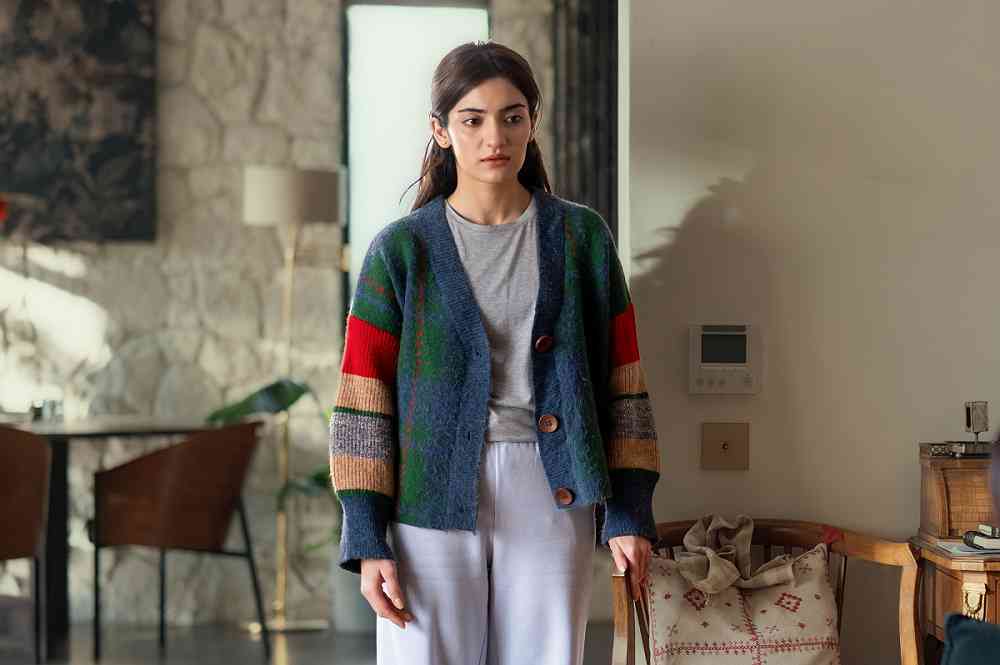
The movie wastes a lot of its screen time simply fleshing out these tropes we have all seen one too many times, and instead misses out on actually being able to explore what it set out to: the disintegration of Geetika’s domestic life. The emphasis on the ensemble of characters also does the film a disservice and prevents it from achieving what it set out to do.
Weak performances do not help the film’s case either. The only convincing performances are delivered by Konkana Sen Sharma, who ends up doing a lot of the heavy lifting, and actor-musician Sanjeeta Bhattacharya, who appears in a brief cameo role.
Weak performances do not help the film’s case either. The only convincing performances are delivered by Konkana Sen Sharma, who ends up doing a lot of the heavy lifting, and actor-musician Sanjeeta Bhattacharya, who appears in a brief cameo role. But this is far from enough for a movie so heavily dependent upon its characters for the narrative.
Burning too bright: Accused fails its own test of ambition
The core of the problem lies in the film’s handling of Dr Geetika’s character arc. Initially, Accused relies on a trope we’ve seen often: the fierce, difficult woman who has built a hard exterior to survive a patriarchal world. But the film tries to be clever by turning this on its head, using Geetika’s harshness to make a broader commentary on the ‘angry feminism’ that is so frequently dismissed today. It asks a provocative question: Is this kind of anger a genuine tool for empowerment, or is it just a reactionary defence mechanism?
By exploring whether Geetika’s professional coldness and her alleged misconduct share the same roots in a desire for control, the film touches upon the intersection of sex, power, and ambition. It’s a brave move to suggest that the same survival instincts that helped Geetika succeed might also lead to her downfall, but the script doesn’t have the patience to let these ideas breathe.
The intersectional sensitivity the film strives for is ultimately sacrificed at the altar of narrative density. By attempting to be a definitive statement on the #MeToo movement, queer domesticity, and the cutthroat nature of medical politics all at once, Accused fails to pack the emotional punch necessary to sustain its thesis. We are left with a series of intellectual vignettes that don’t quite coalesce into a moving portrait of a woman under siege. The lack of dimension in the relationship between Geetika and her wife, Meera, is perhaps the most egregious casualty; without a palpable sense of what is being lost, the tragedy of their unravelling remains purely academic.
Accused serves as a reminder that representation without rigorous, focused storytelling is merely another form of typecasting.
Ultimately, Accused stands as a testament to Konkona Sen Sharma’s ability to elevate even the most fragmented scripts. Her performance is a masterclass in restraint, navigating the film’s melodramatic leanings with a steady, surgeon-like precision. Yet, as the credits roll over the grey London skyline, one is left with the sense that the film, much like its protagonist, is caught in a wildfire of its own making: bright, ambitious, but eventually burning itself out before it can illuminate the very nuances it set out to explore. For a platform like Netflix, which continues to recycle successful archetypes, Accused serves as a reminder that representation without rigorous, focused storytelling is merely another form of typecasting.

Ananya is a writer and researcher of all things literature. With a particular emphasis on film, gender, and sexuality, she is great at curating the perfect movie night, but when it comes to life itself, she’s still figuring out the script.