
Assembly Elections 2026: Assurance on SIR, Model Code of Conduct & more — what EC said on polls for 4 states, 1 UT | India News – The Times of India
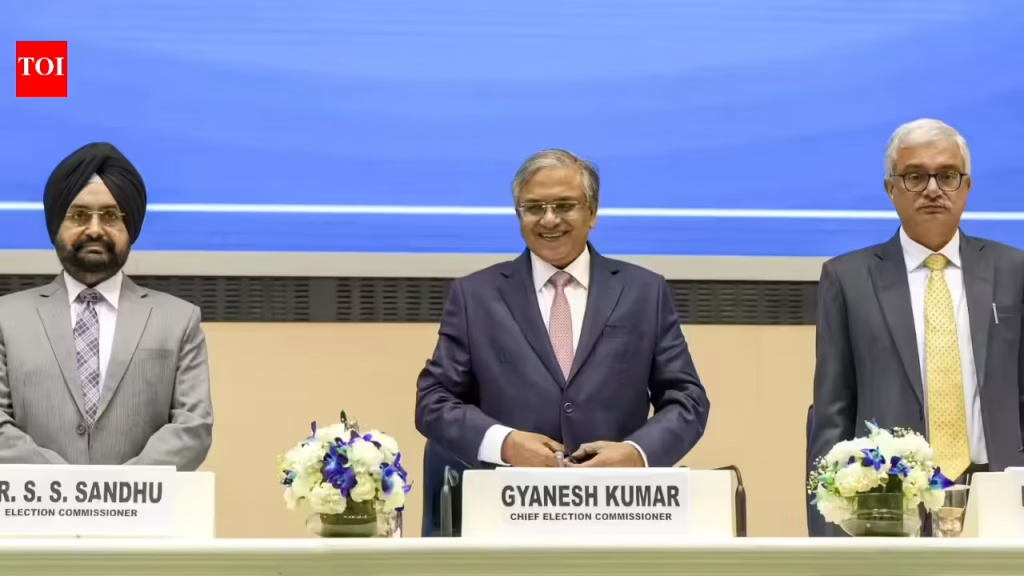
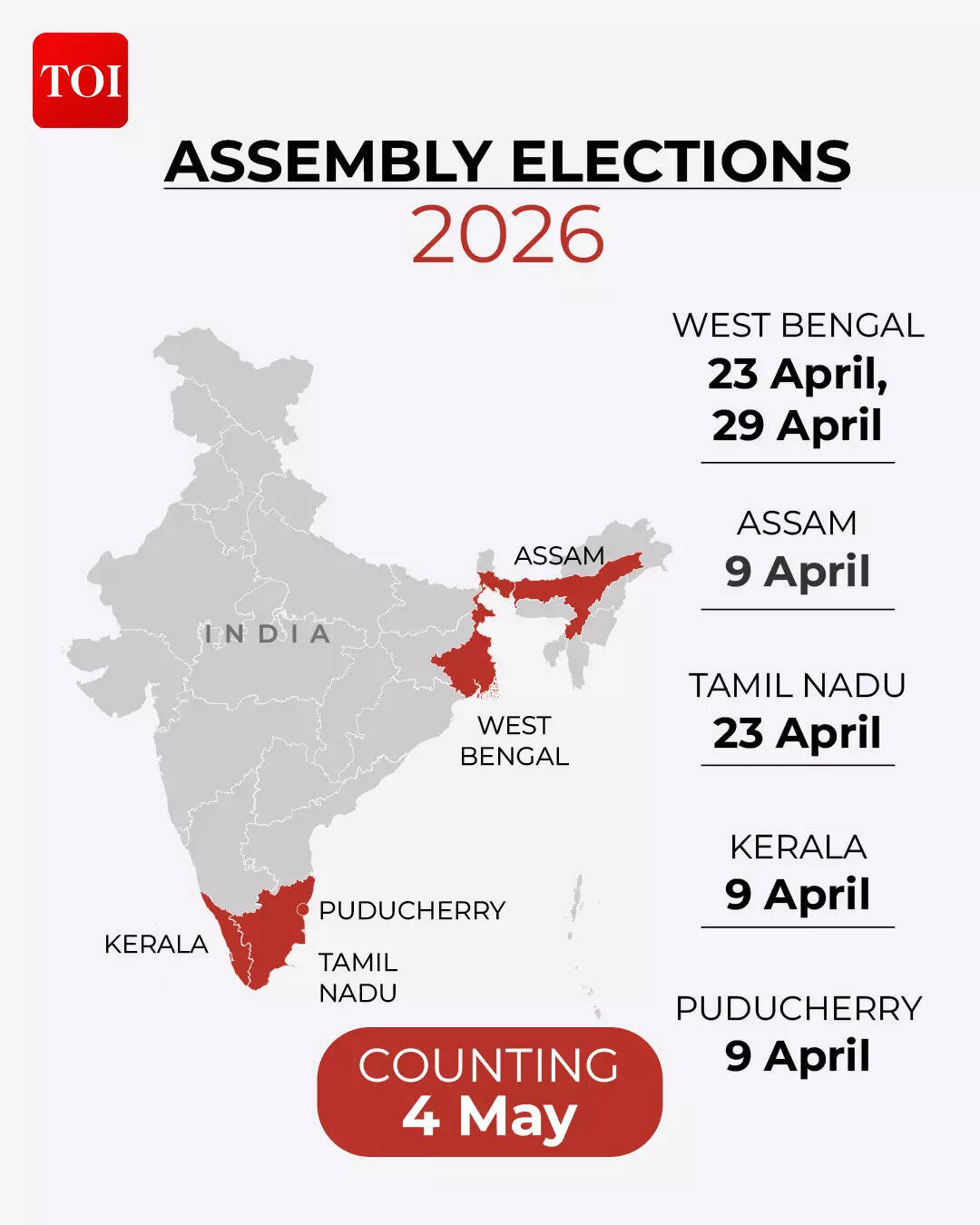
NEW DELHI: The Election Commission on Sunday announced the assembly poll dates for 4 states and one union territory, while detailing several special provisions aimed at improving voter access, monitoring the poll process and strengthening transparency.The EC announced the schedule for assembly elections in — West Bengal, Tamil Nadu, Assam and Kerala — along with the Union Territory of Puducherry.Polling will take place between April 9 and April 29, while results for all five assemblies are set to be declared on May 4. Polling across the five regions will be staggered between April 9 and April 29. Assam, Kerala and Puducherry will vote on April 9; Tamil Nadu will go to the polls on April 23; while West Bengal will vote in two phases on April 23 and April 29.
The Election Commission of India also highlighted the Special Intensive Revision (SIR) of electoral rolls undertaken ahead of the polls, particularly in West Bengal. According to the Commission, the exercise was carried out to improve the accuracy of voter lists by removing duplicate, shifted and ineligible entries and ensuring that only eligible electors remain on the rolls. The Commission said the revision involved door-to-door verification and scrutiny of electoral records by booth-level officers. Officials maintained that the process was aimed at strengthening the integrity of the electoral roll and enhancing transparency in the polling process, according to the EC. Further explaining the process and planning for the polls, the Commission said steps have been taken to expand polling infrastructure and ensure better facilities for voters. “It has been decided that there shall be a maximum of 1200 electors in a polling station,” the Commission noted, adding that additional polling stations or auxiliary booths may be created where voter strength exceeds this limit. To improve voter convenience, the Commission has also directed authorities to provide basic facilities at every booth. “Every Polling Station shall have accessible road in good condition leading to polling station building and is equipped with Assured Minimum Facilities (AMF) like drinking water, waiting shed, toilet with water facility, adequate arrangements for lighting, ramp of proper gradient for the PwD electors and a standard voting compartment.” Special focus has been placed on accessibility for elderly voters and persons with disabilities. The Commission has instructed that polling stations be located on the ground floor or at road level wherever possible, with ramps and wheelchairs provided to facilitate easier voting for senior citizens and differently abled electors. The EC also emphasised strict monitoring of the election process, stating that key events such as nominations, polling and counting will be recorded. “All critical events will be video-graphed,” the Commission said, adding that CCTV cameras and webcasting will be used at polling stations and monitoring points. Additionally, the Model Code of Conduct has come into effect immediately after the announcement of the schedule, applying to political parties, candidates and governments in the poll-bound states. The Commission clarified that “the Model Code of Conduct shall also be applicable to the Central Government so far as announcements/policy decisions pertaining to/for Assam, Kerala, Tamil Nadu, West Bengal and Puducherry are concerned.” It added that extensive arrangements have been made to ensure strict enforcement of the code, warning that “any violation of these Guidelines would be dealt with strictly.” Authorities in the concerned states and Union Territory have also been directed to ensure there is no misuse of official machinery during the MCC period, while election officials have been instructed to maintain heightened vigilance, particularly in the first and last 72 hours surrounding the polling process.