
Jeff Bezos’s rocket company Blue Origin is pausing space tourism, says: To focus on America’s goal of returning to the Moon and… – The Times of India
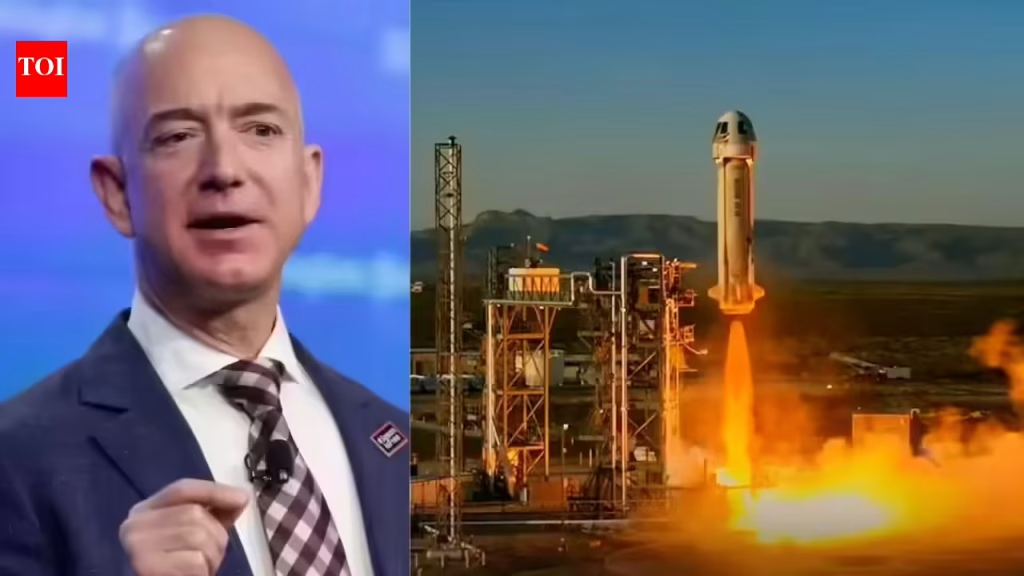
Amazon founder Jeff Bezos‘s rocket company, Blue Origin, is temporarily suspending space tourism. The company has announced it is pausing space tourism flights on its New Shepard vehicle for at least two years to reallocate resources to NASA‘s lunar programme and accelerate development of its human moon-landing capabilities. Blue Origin noted that it will halt New Shepard launches to focus on America’s goal of returning astronauts to the Moon and establishing a sustained lunar presence. The decision affects the reusable rocket system that has carried 98 people to the edge of space, including celebrities such as Bezos’s wife, Lauren Sanchez, Gayle King, and Katy Perry.
What Blue Origin said about pausing space tourism
In a blog post, the company wrote, “Resources will be redirected to further accelerate lunar human flight program.Blue Origin today announced it will pause its New Shepard flights and shift resources to further accelerate development of the company’s human lunar capabilities. The decision reflects Blue Origin’s commitment to the nation’s goal of returning to the Moon and establishing a permanent, sustained lunar presence. New Shepard is the first reusable spaceflight system to vertically land and has flown 38 times and carried 98 humans above the Kármán line to date. New Shepard has launched more than 200 scientific and research payloads from students, academia, research organisations, and NASA. This consistent and reliable performance, combined with an exceptional customer experience, has resulted in a multi-year customer backlog.” In 2021, New Shepard launched on its first flight with four passengers, including Bezos. Two weeks before that, another billionaire, Richard Branson, similarly flew to the edge of space on a space plane built by his space company, Virgin Galactic.The New Shepard rocket does not reach orbit like Blue Origin’s much larger New Glenn vehicle. Instead, it follows an up-and-down trajectory. A capsule atop the rocket, usually carrying people or a payload of scientific experiments, reaches an altitude of 62 miles, which is often considered the boundary of outer space. It then descends under a parachute for a landing. The reusable rocket booster uses its fins to guide itself toward a landing pad, firing its engine for a soft landing.The recent flight, with six passengers, took place last month. Later, Phil Joyce, a senior VP at Blue Origin and head of New Shepard, did not indicate that flights would be suspended.“As we enter 2026, we’re focused on continuing to deliver transformational experiences for our customers through the proven capability and reliability of New Shepard,” Joyce said in his statement from last month.The company, founded by Bezos in 2000, has a NASA contract to provide landers to take astronauts to the lunar surface as part of the agency’s Artemis programme. Initially, the first Blue Origin lander was intended for the Artemis V mission, which was expected to launch in the 2030s.However, SpaceX, which is developing a version of its Starship spacecraft as the lander for Artemis III and IV, has encountered delays, and NASA has requested that both SpaceX and Blue Origin explore ideas to accelerate lander development for Artemis III.“We are absolutely moving forward with both acceleration paths in parallel. We need to do everything we can to help them,” Jared Isaacman, the NASA administrator, said in a recent interview. US President Trump also wants Artemis III to launch by the end of 2028, before his presidency ends.However, revenue from New Shepard is small relative to NASA’s $3.4 billion contract for Blue Origin’s Artemis landers. The company has never announced a price for a ride on New Shepard, which offers a few minutes of free fall. Still, if the average ticket cost $1 million, the 98 passengers to date would have generated less than $100 million.Flights carrying experiments earned some additional revenue. During one of these launches in 2022, the rocket’s booster stage failed, but an emergency escape system carried the capsule to safety.Both Blue Origin’s rocket and Virgin Galactic’s space plane are designed to create a market for suborbital space tourism. But neither company was able to accelerate launch frequency, and people on their waiting lists are stuck on the ground for now.In 2024, Virgin Galactic paused flights of its one operational space plane to focus on manufacturing a new generation of vehicles that outwardly look identical but are designed to fly more frequently and carry six passengers instead of four. Virgin Galactic plans to begin operations of its new spaceplanes this year.New Shepard provided key experience and technology for Blue Origin. A variant of New Shepard’s rocket engine powers the second stage of Blue Origin’s much larger New Glenn rocket.The experience of landing New Shepard boosters also helped the company successfully land the New Glenn booster on a floating barge last year on just the second try, after it launched a small NASA science mission toward Mars.