
Big blow to US missile defence: Iran destroys $300mn THAAD Radar System in Jordan – The Times of India
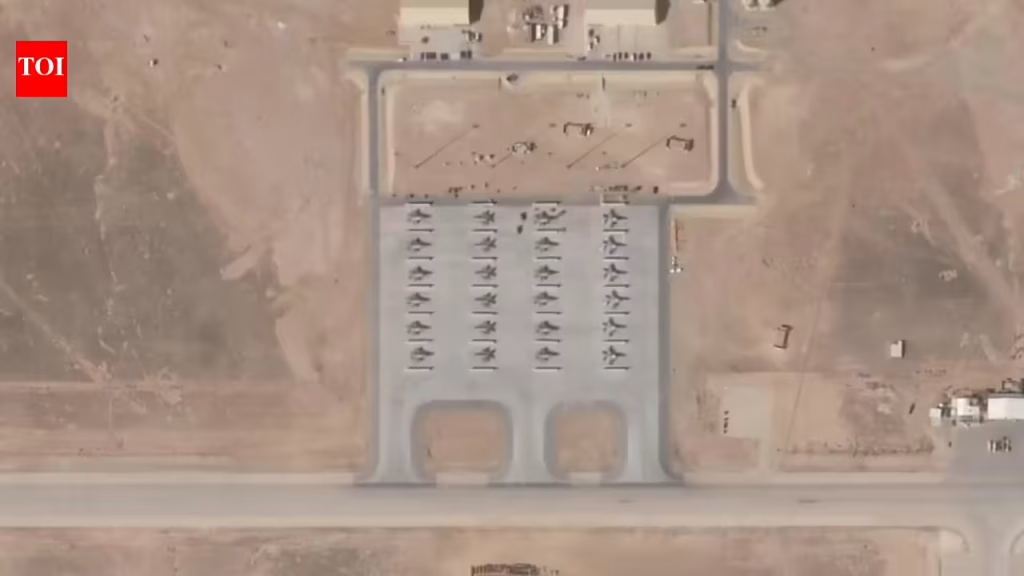
United States’ multi-million radar system was destroyed after Iran struck Muwaffaq Salti Air Base in Jordan in the opening days of the war, news agency Bloomberg reported.RTX Corp. AN/TPY-2 radar and support equipment — used by US THAAD missile defence systems — is crucial to directing US missile defence batteries.According to the report, data compiled by the Foundation for Defense of Democracies shows two reported Iranian strikes in Jordan — on February 28 and March 3 — both of which were intercepted.
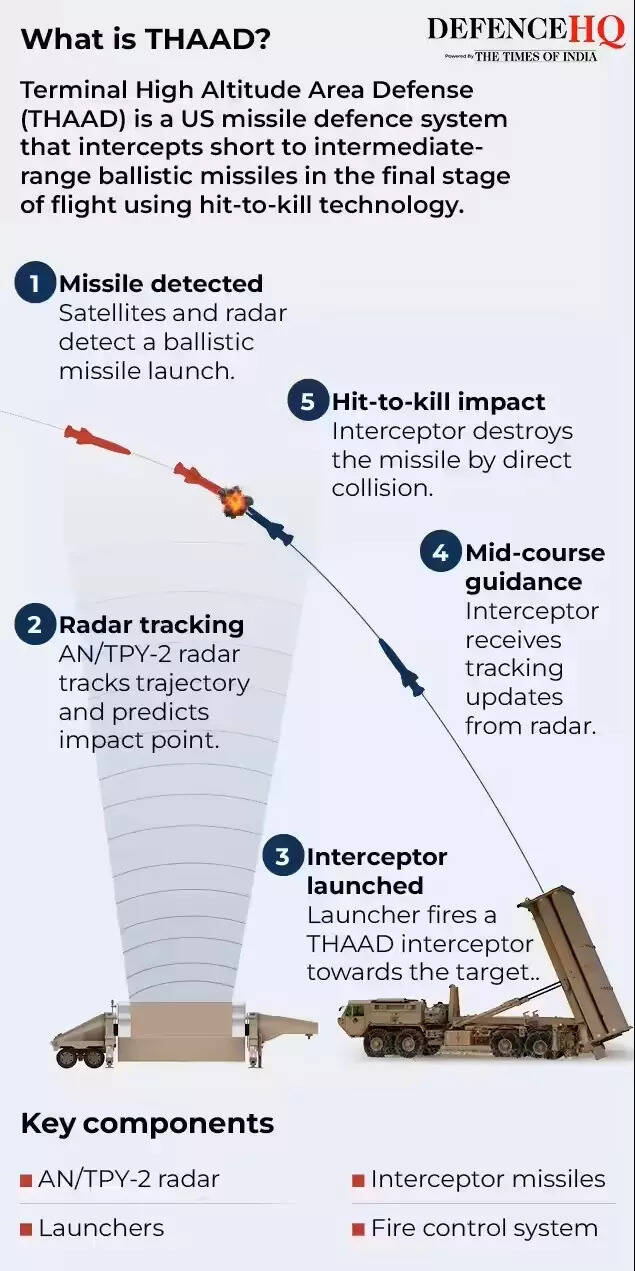
“If successful, an Iranian strike on a THAAD radar would mark one of Iran’s most successful attacks so far,” said Ryan Brobst, deputy director of the Center on Military and Political Power at the think tank.However, he added that the US military and its partners operate other radars capable of sustaining air and missile defence coverage, limiting the impact of losing any single system.The US Terminal High Altitude Area Defence (THAAD) system is designed to destroy ballistic missiles at the edge of the atmosphere, allowing it to intercept more complex threats than shorter-range Patriot missile system batteries.With the AN/TPY-2 radar reportedly out of commission, interception duties would shift to Patriot batteries — where PAC-3 interceptor missile stocks are already in limited supply.
The US operates eight THAAD systems worldwide, including deployments in South Korea and Guam. Each battery costs about $1 billion, with the radar alone accounting for roughly $300 million, according to the Center for Strategic and International Studies.“These are scarce strategic resources and its loss is a huge blow,” said Tom Karako of the think tank. He noted that the US Army’s eight-battery THAAD force remains below the nine-battery requirement set in 2012, leaving little redundancy.A typical THAAD battery includes:
- 90 soldiers
- Six truck-mounted launchers
- 48
interceptor missiles (eight per launcher) - One TPY-2 radar
- A tactical fire-control and communications unit
- Each interceptor missile, manufactured by Lockheed Martin, costs about $13 million.
“If you want integrated air and missile defence, this is just one of the systems you would deploy in the theatre,” said William Alberque of the Pacific Forum.Earlier in the war, an AN/FPS-132 radar in Qatar — a fixed installation unlike the mobile THAAD radar — was also damaged during an Iranian attack, according to research from the James Martin Center for Nonproliferation Studies in Monterey, California.The system functions as an early-warning radar, capable of detecting threats at extreme distances but lacking the precision required to guide interceptors.Air and missile defence networks across the Gulf region have been heavily strained by waves of Iranian drones and ballistic missiles, raising concerns that stockpiles of advanced interceptors such as THAAD and PAC-3 could soon run dangerously low.On Friday, defence contractors including Lockheed Martin and RTX Corporation met at the White House as the Pentagon pushes to accelerate weapons production.