
‘Underwater Panda’ discovered near Japan: Tiny 1-inch translucent marine species found 20 meters deep under sea | – The Times of India
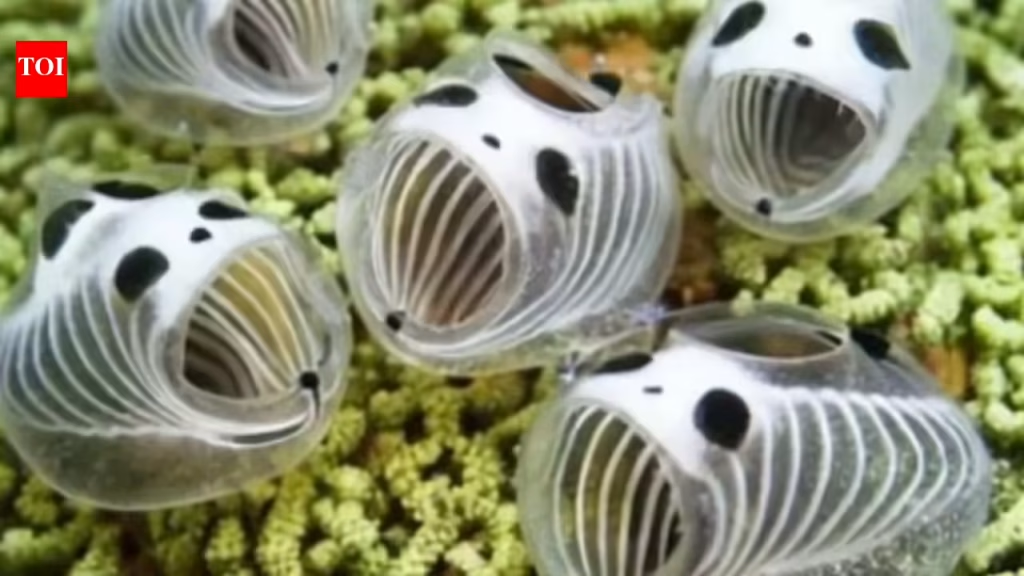
Marine exploration often reveals unusual life forms that remain hidden beneath the ocean surface for years. In the past few years, divers and scientists have used underwater photography and careful observation more and more to find species that had never been scientifically documented before. One such discovery has come from the waters near Kumejima Island in Japan, where scuba divers found a small marine organism that quickly caught the world’s attention because of how strange it looked.The animal is only 2 centimetres long, or less than an inch, and its body is white and see-through, with dark markings that look like a panda’s face. Because of how it looks, it quickly became known online as the “underwater panda.” Later, scientists confirmed that the creature is a sea squirt and gave it the official name Clavelina ossipandae, which is also known as the Skeleton Panda Sea Squirt. Researchers from Hokkaido University studied specimens collected from the site and wrote about the species. The find shows how little we still know about marine biodiversity and how small organisms can have big effects on ocean ecosystems.
Japan’s ocean hides a bizarre ‘Underwater Panda’ barely an inch long
The tiny marine species was first noticed by local scuba divers exploring waters around Kumejima Island, which is part of Okinawa Prefecture in southern Japan. Divers encountered the organism at a depth of approximately 20 meters below the ocean surface.As it looked strange, divers took pictures of the organism and posted them online. The creature appeared almost transparent, with white rib-like patterns and dark markings that gave it a panda-like facial expression. Its body size was extremely small, measuring around 2 centimetres.These images eventually reached marine researchers, including Dr Naohiro Hasegawa from Hokkaido University. After looking at the pictures, he thought that the organism might be a new species that had not yet been written about in scientific journals.
Scientists identify the Skeleton Panda Sea Squirt (Clavelina ossipandae)
Following the discovery, Dr Naohiro Hasegawa travelled to Kumejima Island to examine the organism directly. He conducted dives to the same underwater location where the divers had first observed the creature and collected specimens for detailed analysis.The research was later published by scientists Naohiro Hasegawa and Hiroshi Kajihara. In their scientific paper titled “Graveyards of Giant Pandas at the Bottom of the Sea? A Strange-Looking New Species of Colonial Ascidians in the Genus Clavelina (Tunicata: Ascidiacea)”, the researchers confirmed that the organism was a previously undocumented species of colonial ascidian.The official name for the species is Clavelina ossipandae, but people usually call it the Skeleton Panda Sea Squirt. The name comes from the way the creature looks, which is like small panda skeletons grouped.An ascidian is a type of marine invertebrate that lives in the ocean. They are simple life forms that live on surfaces in the ocean and often group together.
Why does the creature look like a panda
The panda-like appearance of the species is actually a visual effect created by internal structures in its body. Scientists clarified that the white “bones” visible through its transparent body are not bones at all.Instead, these structures are translucent transverse vessels located in the pharynx, which form part of the animal’s internal filtering system. When you look through the clear tissue, you can see that these vessels run horizontally across the body and make a pattern that looks like ribs.Dark spots around the head make the panda face look more real. When many individuals grow close together in a colony, the cluster can resemble a group of tiny panda skeletons. Researchers emphasised that the appearance is a biological illusion created by anatomy rather than actual skeletal structures.
How the Skeleton Panda Sea Squirt survives in the ocean
Despite its extremely small size, the Skeleton Panda Sea Squirt performs an important ecological function in its environment. The organism survives by filter feeding, just like other ascidians. It pumps seawater through its body and filters out small food particles, like bacteria and plankton.The clear transverse vessels inside the body support the gill mesh. The gill mesh acts like a natural filter. As water flows through this mesh, food particles get stuck in it, and the organism eats them. This feeding process also gets rid of things that are floating in the water around it. The sea squirt filters out these things to help keep the water in coral reef ecosystems clear.
Importance of sea squirts in marine ecosystems
People often don’t notice sea squirts because they are small and simple. Marine scientists do know, though, that ascidians are important in ocean environments. Their filtering activity helps regulate water quality by removing bacteria and microscopic debris. This process can help keep the water clearer in coral reef habitats, which lets sunlight reach corals more easily.Corals need sunlight to live because many of them have photosynthetic algae living in their tissues. So, clear water conditions help the whole reef ecosystem. Although the Skeleton Panda Sea Squirt is very small, organisms like it contribute to the complex balance of life in reef environments.
Why the species is found near Kumejima Island
So far, the Skeleton Panda Sea Squirt has primarily been observed around Kumejima Island. Scientists think that the island’s one-of-a-kind underwater conditions might help the species. Coral reefs, rocky surfaces, and strong ocean currents are all found in the area. These things can make good places for colonial ascidians to attach and grow.Currents also move water that is full of nutrients and has tiny food particles that filter-feeding organisms need. These environmental factors may elucidate the presence of Clavelina ossipandae colonies in this region.Further marine surveys may determine whether the species exists in other parts of the Pacific Ocean.
Why the Skeleton Panda Sea Squirt is considered rare
Although divers had photographed the organism before, it was not formally recognised by science until researchers studied it in detail. The species remained undocumented in scientific records until the research publication describing it.Scientists think the species is rare right now because they have only found it in a small area and in small groups. But sometimes, rarity is a sign of limited observation rather than true scarcity. Many marine organisms are still unknown or not well studied because it’s hard to explore large parts of the ocean floor. Ongoing diving surveys and marine research might uncover more populations of this species.