
Mojtaba Khamenei: Iran crisis: Ayatollah’s son Mojtaba Khamenei emerges as front-runner to succeed slain Supreme Leader – report – The Times of India
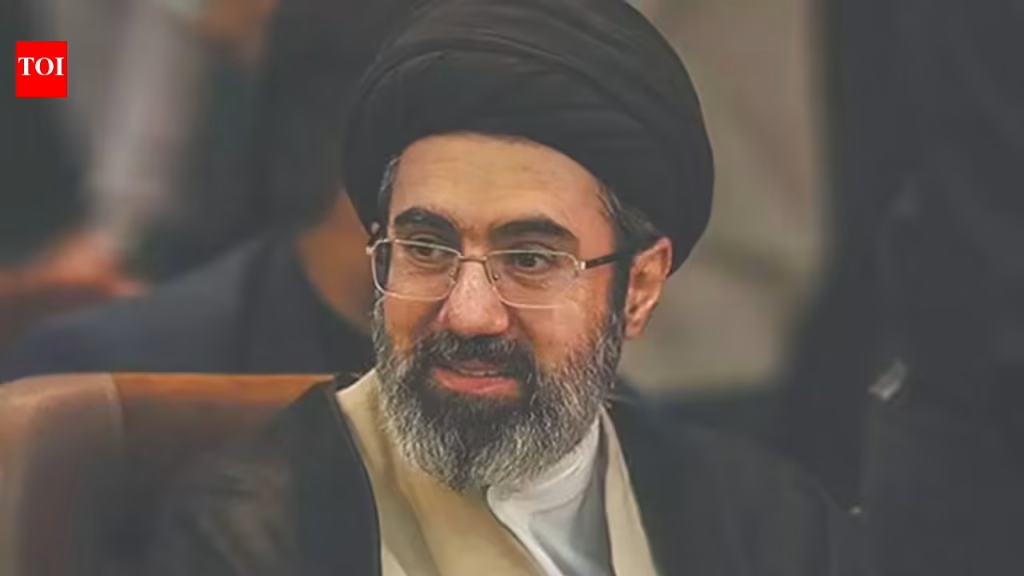
Iran’s powerful Assembly of Experts has elected Mojtaba Khamenei, son of the slain Supreme Leader Ayatollah Ali Khamenei, as his successor under pressure from the Islamic Revolutionary Guard Corps (IRGC), reported Iran International, citing informed sources.However, according to the New York Times, senior clerics responsible for choosing the next supreme leader were still deliberating on Tuesday, with Mojtaba emerging as the clear front-runner but no formal announcement made yet.
Assembly of experts meets amid crisis
The New York Times reported, citing three Iranian officials familiar with the discussions, that the 88-member Assembly of Experts held two virtual meetings on Tuesday, one in the morning and one in the evening, to deliberate on the succession.The clerics were considering announcing Mojtaba Khamenei as early as Wednesday morning, but some members expressed reservations, fearing such a move could make him a target for the United States and Israel, the officials said on condition of anonymity.Israel struck a building in Qum, one of Shiite Islam’s main religious centres, where the assembly had been scheduled to meet. However, the building was empty at the time, according to Iran’s Fars News agency.The Assembly of Experts is constitutionally mandated to appoint, supervise and, if necessary, dismiss the supreme leader. This marks only the second time in the Islamic Republic’s 47-year history that the body will select a leader. In 1989, it chose Ali Khamenei following the death of Ruhollah Khomeini.
IRGC backing and hard-line signals
According to the New York Times, the IRGC pushed for Mojtaba’s appointment, arguing that he possesses the qualifications needed to guide Iran through the current crisis following the US-Israeli strikes that killed his father.“Mojtaba is the wisest pick right now because he is intimately familiar with running and coordinating security and military apparatuses,” Tehran-based analyst Mehdi Rahmati told the newspaper. “He was in charge of this already.”Vali Nasr, an Iran expert at Johns Hopkins University, described Mojtaba as a surprising yet telling choice.“He was slated to become the successor for a long time,” Nasr said. “But for the past two years, it seemed to have dropped off from the radar. If he is elected, it suggests it is a much more hard-line Revolutionary Guard side of the regime that is now in charge.”Mojtaba Khamenei, 56, is known for his close ties to the IRGC and has long operated behind the scenes within the Office of the Supreme Leader.
Public backlash and reformist concerns
Rahmati warned that Mojtaba’s elevation could spark domestic backlash.“A portion of the public will react negatively and forcefully to this decision, and it will have a backlash,” he predicted.Supporters of the government may view him as a continuation of a leader they regard as martyred, while critics could see his succession as entrenching a system accused of violently suppressing protests in recent months.Other reported finalists include Ali Reza Arafi, a member of the three-person transition council, and Hassan Khomeini, grandson of Ayatollah Ruhollah Khomeini. Both are viewed as relatively moderate figures, with Hassan Khomeini seen as close to Iran’s sidelined reformist faction, according to the New York Times.Abdolreza Davari, a politician close to Mojtaba Khamenei, told the New York Times that if he succeeds his father, he could adopt a reformist posture similar to Saudi Arabia’s de facto ruler Mohammed bin Salman.“He is extremely progressive and will move to sideline the hard-liners,” Davari said in a text message before the war. “See his appointment as a shedding of skin.”
Who is Mojtaba Khamenei?
Mojtaba Khamenei was born in 1969 in Mashhad and came of age during the 1979 Islamic Revolution that toppled Shah Mohammad Reza Pahlavi. He later studied in Tehran and Qom under conservative clerics, including Ayatollah Mohammad-Taqi Mesbah Yazdi.Though a mid-ranking cleric and not an ayatollah, Mojtaba has been widely regarded as one of the most influential figures within Iran’s power structure. Analysts have compared his role to that played by Ahmad Khomeini, who acted as a gatekeeper to his father during the early years of the Islamic Republic.Mojtaba’s influence is closely tied to his longstanding relationships within the IRGC. He served in the Habib Battalion during the Iran-Iraq War and cultivated ties with security and intelligence officials who later rose to prominence.He was sanctioned by the United States in 2019 under an executive order targeting individuals linked to the Supreme Leader. The US Treasury at the time said Ali Khamenei had delegated aspects of his authority to his son, despite Mojtaba holding no elected office.
Constitutional hurdles and interim mechanism
Under Iran’s constitution, the supreme leader must be a senior cleric with recognised religious authority and political competence. Mojtaba does not currently hold the rank of ayatollah, and hereditary succession is sensitive in a system born out of opposition to monarchy.Following Ali Khamenei’s death, senior official Ali Larijani indicated that an interim leadership council — comprising the president, the judiciary chief and a jurist from the Guardian Council — would ensure continuity until a new leader is formally selected.Meanwhile, US President Donald Trump, speaking in Washington, said many figures previously seen as potential Iranian leaders had been killed in recent strikes.“Pretty soon we’re not going to know anybody,” he said. Asked about a worst-case scenario, Trump added: “I guess the worst case would be we do this and somebody takes over who’s as bad as the previous person. Right, that could happen. We don’t want that to happen.”