
Gender Creativity In Queer Illustrated Fiction For Children
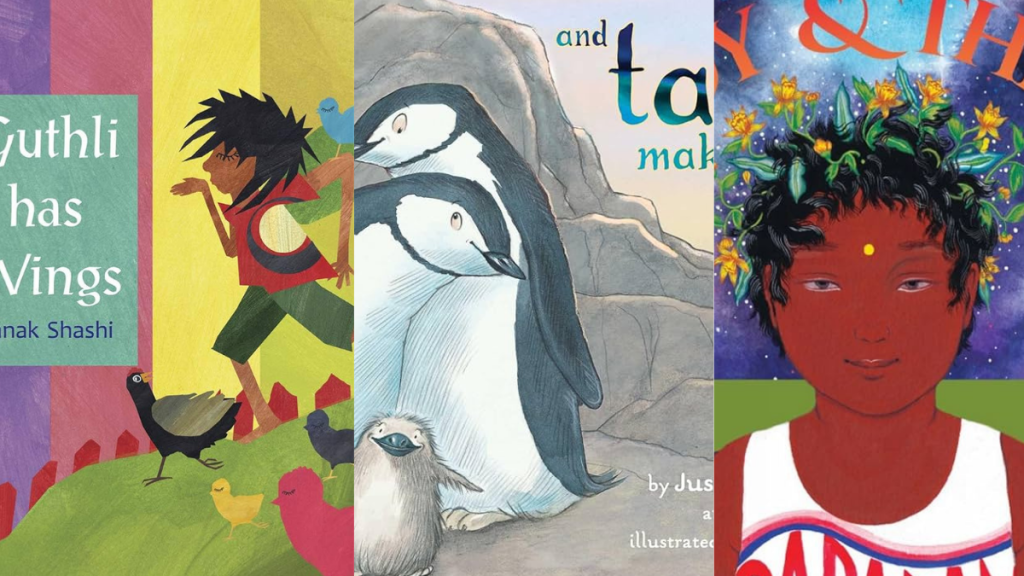
The figure of the queer child, for the longest time, has been absent from the realm of popular children’s fiction. Even if the queer-coded child figure did exist, this “queer child is distorted, manipulated and forcibly made to appear straight in children’s books, in order to appeal to the adult’s conception of the normative heterosexual world order,” as scholar Sarkar noted. The rise of depictions of relatively younger queer experiences is very recent.
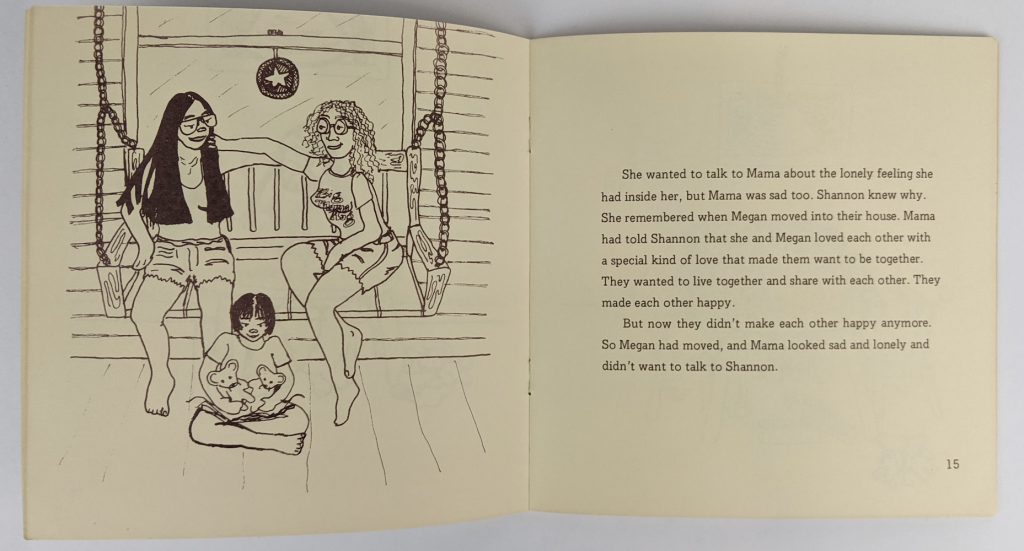
Moreover, When Megan Went Away, the first published picture book to feature queer characters, came out in 1979, more than forty-five years ago. The picture book revolves around two lesbian mothers and their imminent divorce. Since then, the sub-genre of queer illustrated fiction has expanded to include stories about queer animals. And Tango Makes Three, a real-life story about gay penguins in Central Park, New York City, is one of the best-known and most widely read queer picture books, a subversion of heteronormative wedding traditions and a celebration of children discovering their gender identities through creative outlets.
This last narrative device will be the focus of this piece, and to explore ‘gender creativity’, two picture books by South Asian authors are used as primary texts: Guthli Has Wings (2019) by Kanak Shashi and The Boy and the Bindi (2016) by Vivek Shraya and Rajni Perera. Guthli perceives herself as a fairy, and the unnamed boy in The Boy and the Bindi has an epiphany about his gender through the bindi on his mother’s forehead.
While writing and building these narratives, how do authors and illustrators go beyond the linear process of gender discovery? Do illustrations reinforce queer stereotypes, or does it become essential to rely on stereotypes to provide a gateway to their early perceptions of queerness? This piece examines the depiction of the trans and gender-nonconforming experience of the child figure in queer illustrated fiction and how the use of LGBTQ+ terminology is, hence, gender-creative.
Gender creativity 101
The term ‘gender creativity’ first appeared in Diane Ehrensaft’s resource book for parents on raising gender-creative children, The Gender Creative Child: Pathways for Nurturing and Supporting Children Who Live Outside Gender Boxes. The term is used to “describe children whose unique gender expression or sense of identity is not defined by a checkbox on their birth certificate,” according to Ehrensaft. However, there is much more to gender creativity, as it helps children use their imagination to understand and incorporate their gender into the world around them.
In this paper, gender creativity is a model for rethinking alternative ways to represent the exploration and expression of gender that go beyond discovering labels online. In the case of children who are just learning to step into the world and find themselves, accessing the internet to discover labels that fit their gender identity is a far-fetched concept. Children are inherently curious about the world, and they make sense of themselves and the world around them through experience, be it cultural or fantastical. They latch onto a symbol that catalyses their identity formation and explore it in full until they are comfortable with it. The symbols in the texts range from dresses and fairies to accessories and cultural markers like bindis.
Gender creativity through illustrations
Symbols and illustrations in picture books are quite easy to attract children. These books not only help them hold a mirror to their experiences with gender through pictures, but also provide a window into representations outside. The format of the picture book facilitates understanding perspectives and taking up ‘subject positions’ for children because the ‘subject’ is their age (Sarkar 16). The narrative is entirely focused on the child figure, with other figures such as parents, friends, and society playing a supporting role in pushing it forward.
The two primary texts use illustrations in distinct ways, corresponding to the narrative’s tone and characters. Guthli Has Wings introduces us to Guthli, a young, playful girl and the youngest member of her family. She is like any other child; she draws fairies, roams the Satpura hills for hours and collects leaves of different kinds (Shashi 7). However, she wears her sister’s frocks and receives scathing remarks from her mother for dressing ‘like a girl’ “because [she is] like her brother, not like [her] sister” (Shashi 13). Guthli’s illustrated figure does not have eyes throughout the book, which could be the author-illustrator’s way of universalising Guthli’s experience of her gender identity with other children worldwide. By deliberately deleting one of the most characteristic features of her face, the author presents Guthli as a representative symbol of the gender-creative child.
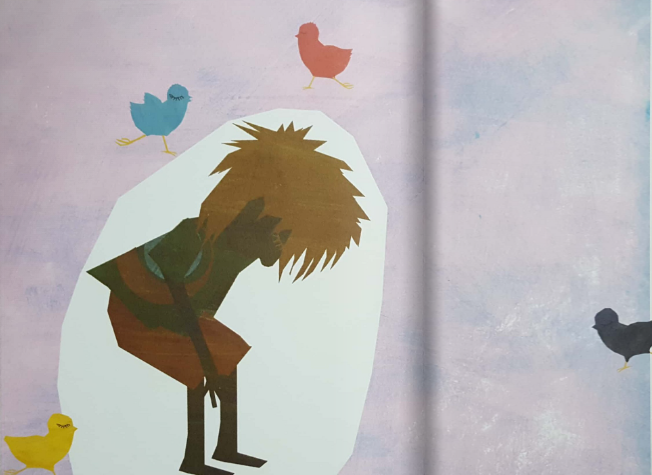
The paper cutout art style of the picture book also reflects the disharmony Guthli feels between her body and mind. The haphazard paper cutouts also reflect many aspects of Guthli’s life at this point: the constant mockery from her family, particularly her mother, about her gender identity and presentation, followed by her feelings of loneliness and sadness after the spiteful comments. She isolates herself during Diwali and does not speak to anybody, the isolation thus taking the form of a dysphoric experience because her family invalidates her identity by referring to her as a boy. “Interestingly, the illustrations also do not…portray Guthli as a boy or girl, portraying her more as a [genderless] child, with her dishevelled hair (Sarkar 16).”
The uneven cutouts of Guthli’s hair are also chaotic and experimental, serving as a way for her to navigate her trans identity by experimenting with the length and shape of her hair, as they represent. Shashi may also be commenting on the very nature of the gender discovery process through this art style; discovering and coming to terms with one’s gender identity is not a linear process, and it entails several ups and downs and setbacks from society and from oneself. The paper cutouts are also an intentional choice, keeping the target audience in mind, because children also develop hobbies by indulging in hands-on activities like arts and crafts.
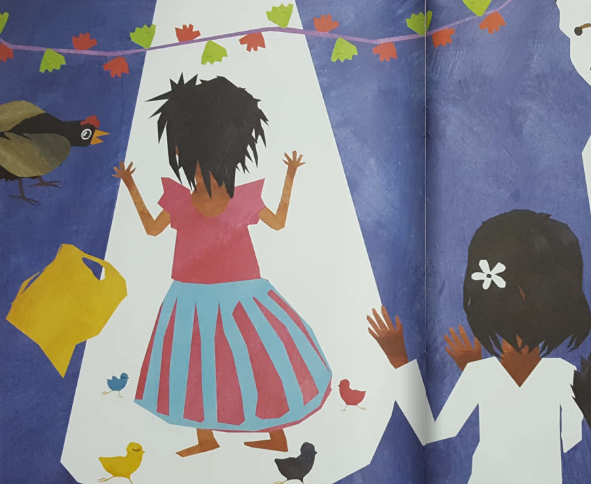
In addition to the irregular paintbrush strokes and cutouts, the colour palette also aligns with Guthli’s fluctuating moods throughout the story. When she retreats into herself, Guthli’s entire physical form becomes dark and unclear to decipher, unlike her previous and later, more colourful illustrations. When Guthli’s mother finally accepts her for who she is, the colour palette becomes traditionally feminine, thereby aligning with established societal norms in which certain colours are associated with certain genders – girls like pink and boys like blue.
Gender creativity through language
In addition to the illustrations, Shashi and Shraya leave the gender identities of their protagonists unlabelled. The interpretive writing style also complements the playfulness of gender that is available to these characters.
The Boy and the Bindi is about a young boy’s curiosity about a single object that sparks a spiritual journey. He watches his mother put on a bindi and is curious about its form and function. Once his mother gives him a bindi to put on, he begins feeling safe in his skin and experiences something spiritual, something he does not label clearly.
He says that bindis come in every hue, which could be construed more metaphorically as genders having many hues and hence a multiplicity of genders beyond the binary to choose from. While the book’s message is more spiritual and geared towards a broader cultural epiphany for the child, Shraya has also kept the target audience and their optimal reading level in mind. There is a rhyming scheme of AABB on almost every page, which, when read out loud, sounds playful and not as didactic as a book of the same genre, but one that catered to a much older audience would sound like. Some examples include “She peels and pastes it like a sticker/Gently with her thumb and finger” and “Ammi, why do you wear that dot? What’s so special about that spot? (Shraya)”
Although stereotypes, ranging from mildly dysphoric experiences to the use of pink and blue as the primary colours to depict gender, project themselves onto the pages of queer picture books, they are essential in building children’s first impressions of gender. Such stereotypes help them become creative and experimental with their gender, as established in both texts. Instead of discovering complex words like ‘transgender’ and ‘non-binary’, children playfully experiment with their gender identity and gender presentation by using cultural symbols and fantastical elements.
References
- Ehrensaft, Diane. The Gender Creative Child: Pathways for Nurturing and Supporting Children Who Live Outside Gender Boxes. The Experiment, 2016.
- Sarkar, Ananya. “Why Do You Keep Saying I’m a Boy When I’m a Girl?: Exploring Queer Desires, Identities, and Expressions in Indian Children’s Illustrated Fiction.” Journal of Comparative Literature and Aesthetics, vol. 46, no. 3, 2022, pp. 14–25. jcla.in/wp-content/uploads/2023/07/JCLA-46.3_Autumn-2023_Ananya-Sarkar.pdf.
- Shashi, Kanak. Guthli Has Wings. Tulika Publishers, 2020, anyflip.com/njumx/mizs/basic.
- Shraya, Vivek. The Boy and the Bindi. Arsenal Pulp Press, 2016.

Ayushi Pandey is a recent graduate from FLAME University, Pune and has a BA in Literary and Cultural Studies and Postgraduate Diploma in Interdisciplinary Studies and Research. They have a keen interest in queer literature, publishing and modern South Asian studies and aim to pursue these disciplines further.