
The Female Consciousness In Virginia Woolf And Jean Rhys’ Works
Where does the female consciousness exist in modernist literature? The idea of ‘space’ as a metaphysical concept manifests in manifold ways. The notion of space may be contrasted with that of ‘place’. A ‘space’ transcends the boundaries of the physical place. While a physical place can be a space, space entails more than just place. It is socio-culturally and consciously constructed by those inhabiting the space. It can be examined with respect to who occupies it, how, where and when, and these aspects of space are intricately tied to societal notions of gender, class and hegemony. How do the external, or physical, and internal, or psychological, affective spaces interact with each other? How are they transformed by the manner in which they exist within and outside an individual’s gender, sexuality, and class?
This essay seeks to examine the interspatial existence of female consciousness as shaped by society, and the ways in which it subtly subverts the oppression of such shaping. For this purpose, this essay will analyse the two Modernist works, A Room of One’s Own by Virginia Woolf, and Good Morning, Midnight, by Jean Rhys. Both these novels follow female protagonists as they navigate male-dominated, hegemonically patriarchal spaces and places. Their thoughts and actions are directly influenced by the physical places they are in and socially constructed by norms of class, gender, and sexuality.
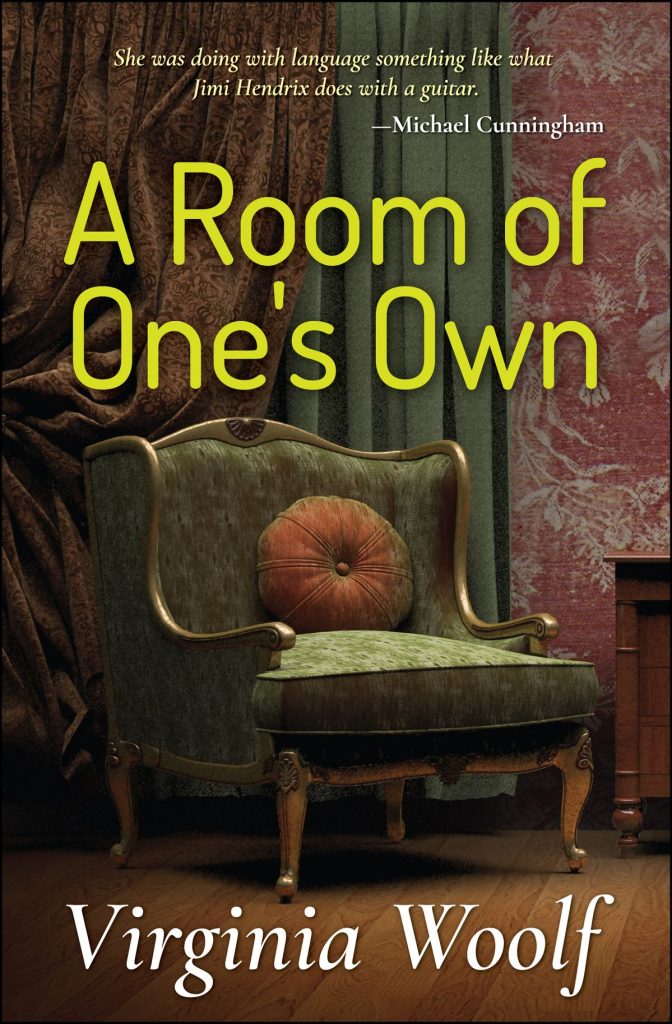
Virginia Woolf, born Virginia Stephen, was a British author known for her nonlinear approaches to narrative in her novels, the most famous of which are Mrs Dalloway (1925) and To the Lighthouse (1927). She also wrote pioneering essays on artistic theory, literary history, women’s writing and the politics of power. A Room of One’s Own is one such essay by Virginia Woolf published in 1929. The work was based on two lectures given by the author in 1928 at Newnham College and Girton College, the first two colleges for women at the University of Cambridge. In this essay, considered a seminal work of feminist literature, Woolf asserts that a woman must have money and a room of her own to write.
Jean Rhys was a West Indian novelist who spent her childhood in Dominica, then moved to London at the age of 16, where she worked as an actress before moving to Paris. There, she was encouraged to write by the English novelist Ford Madox Ford. Her most famous work is Wide Sargasso Sea (1966), a novel that reconstructs the earlier life of Antoinette Cosway, Edward Rochester’s mad first wife in Charlotte Brontë’s Jane Eyre. Published in 1939, Good Morning, Midnight was her fourth novel. It explores a middle-aged woman, Sasha Jansen’s feelings of depression, loneliness, vulnerability, and desperation using Modernist techniques of fragmentation and stream of consciousness.

In A Room of One’s Own, the narrator repeatedly encounters restrictions in the spaces she is allowed to access due to her being a member of the feminine sex. She tries to access the library of Oxbridge University but is denied entry on account of her gender by a “kindly gentleman”, who regretfully informs her that “Ladies are only admitted to the library if accompanied by a Fellow of the College or furnished with a letter of introduction (Woolf 12).” She further contemplates how being “cursed by a woman is a matter of complete indifference to a famous library (Woolf 12).” This shows how the physical place of the inanimate library does not discriminate, but the gendered restrictions placed on who can access the library socially and politically construct it as a discriminatory space. This denial of entry impacts the internal, affective space of the narrator’s psyche, as she vows to “never ask for that hospitality again” in helpless frustration, which further impacts her navigation of other physical spaces, as she hears the sound of a church organ, has no desire to enter the chapel even if she had the right, out of self-righteous indignance, at the dry thought of the verger stopping her demanding her baptismal certificate (Woolf 13). This is just one of many instances of interaction between internal and external spaces.
Patriarchal hegemony over the female consciousness
In an instance of overtly exercised patriarchal hegemony over the woman’s intellectual life, the narrator’s stream of thought is interrupted when she walks on the turf only to be impeded by her identity as a woman and its accompanying socially sanctioned restrictions on the spaces she is allowed to navigate and those that she is not. Spurred by the intellectual vigour in the formation of a new idea, she starts walking briskly across a grass plot when a man stops her. In a brief moment of hesitation, she realises instinctually what is wrong: “He was a Beadle; I was a woman. This was the turf; there was the path. Only the Fellows and Scholars are allowed here; the gravel is the place for me (Woolf 9).” The resigned tone of her internal monologue shows her acceptance of the futility of rebelling, and the interruption disrupted her train of thought. In barring her from walking on the physical space of the turf, the Beadle, as an authoritative agent of the patriarchal system, thus encroaches upon a woman’s freedom of thought and intellectual expression, raising questions about the nature of internal space and to the extent to which it is truly one’s own, free space, and about who has the freedom to have an uninterrupted train of thought.
In contrast to the narrator in A Room of One’s Own, who had been walking, lost in her own thoughts, unaware of her surroundings, we have the protagonist of Good Morning, Midnight, Sasha, who is excessively aware of her surroundings. If the narrator’s train of thought in A Room of One’s Own is interrupted by masculine authority, then Sasha’s is entirely shaped by it. She is always aware of how she perceives others and how she is perceived in different spaces. Her internal affective space does not exist of itself, regardless of the external spaces she is in, but is a direct product of physical places and the presence of others in those spaces. Her psychological space is fragmented into two versions of herself, or inner voice, “The active voice of desire and the passive voice of her social role (Gardiner 249).”
Fragmentation of the Female Consciousness
In an awkward interaction with her employer, Mr Blank, who makes her feel humiliated to the point of tears, she carries on an internal monologue. Here, she soliloquises about how he represents patriarchal Society, and has the right to alienate her socially, mentally and physically through inadequate opportunities of recreation and fulfilment, but he does not have the right to ridicule her for the consequences that have on her behaviour. Yet, externally, she remains quiet. This mode of retrospection shows how the gendered external space shapes her inner affective and cognitive space, and how it becomes a respite, a solace from the oppressive, patriarchal external space.
There is a dynamic fluidity between the fragments of Sasha’s self: one flows into the external spaces around her, while the other sits within her, going off on fictional tangents as a way to cope with a reality she is alienated from.
In Good Morning, Midnight, Sasha often inhabits transitory, liminal spaces distinct from physical places. For instance, in a dream, she finds herself in the passage of a Tube station in London, where people seem to be going to an Exhibition. A man shouts ‘murder, murder’, and she, too, shouts for help and wakes up to hear a man singing a waltz (Rhys 4). The liminal space of the Tube passage represents an external place within her unconscious. She is abruptly woken up by the rising intensity of the screams in her dream, to the jarring sound of a man singing. The male presence in both internal and external spaces is discomforting and jarring to the feminine mind, and the reader is not unaware of this.
The dynamics between internal and external spaces have been explored in this paper through the feminine narrators of A Room of One’s Own by Virginia Woolf and Good Morning, Midnight by Jean Rhys as they navigate an oppressive, patriarchal society. The interspatial dynamics result from the confluence of multiple social constructs, such as gender, sexuality, and class. Yet there is a blurring of boundaries as the consciousness of the characters fluidly navigates between the two, oppressed by the patriarchy in different ways. In both the works, the narrators find different ways to challenge the systems that oppress them, for Virginia Woolf, it is a room of one’s own, while for Jean Rhys, it is Sasha’s stark acceptance and conflict with alienation and the futility of social performance.