
Unequal Access, Unequal Safety: Women Reporters In Delhi Facing Barriers In Field Work
In 2026, as India grapples with ongoing concerns over press freedom and journalist safety amid reports of heightened risks for women in media, women reporters in Delhi continue to face structural barriers in field assignments, including unequal access to sources, safety threats, and gender-based exclusion from key beats.
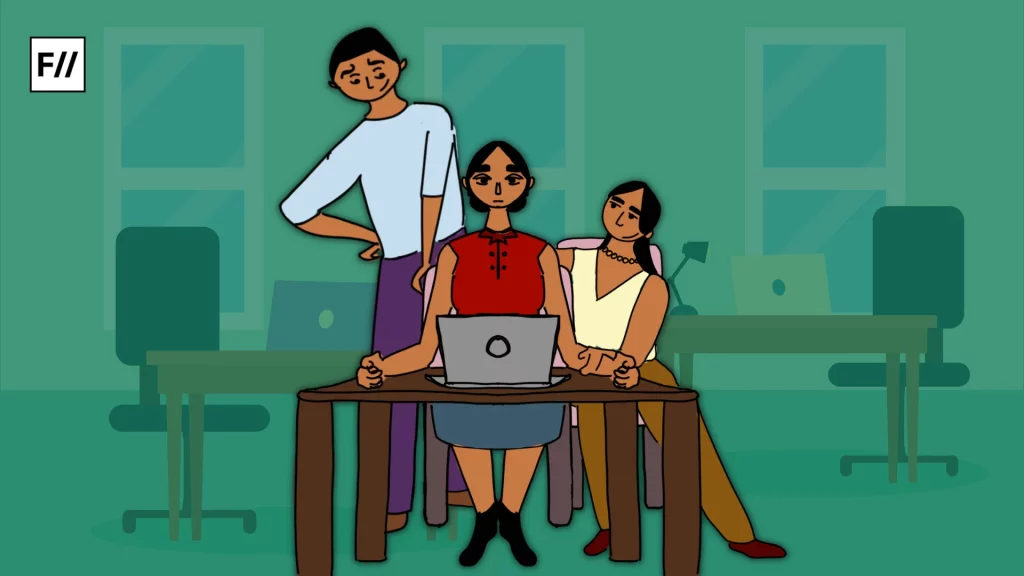
Mrinalini Dhyani, an independent journalist who has worked with The Print and Mojo Story recalled a press briefing organised by Railway Minister Ashwini Vaishnaw, where she was the only woman at the table and how another woman with a camera and tripod entering the room created a moment of mutual recognition. ‘That is how it has been for us. You will be mansplained to and not taken seriously, and no matter if it is 2026, you will still be given the soft beats.‘ Speaking about newsroom practices, Mrinalini added, ‘Ensuring a woman’s safety while sending her on assignment is often seen as an added burden in Indian newsrooms. And so, most of the time, the opportunity is passed on to male counterparts because ‘with them, there’s supposedly no security concern’.
Normalisation of Exclusion: From Press Briefings to Beats
For many women reporters, exclusion is not only about personal safety but also professional access. “The very fact that the male counterparts did not find anything uncommon about the absence of female journalists in the room shows how deeply this has been normalised,” she remarked on the Taliban press briefings in Delhi.
Himanshi Dahiya, special correspondent at The Quint, pointed out, “There are certain beats, be it the crime beat or politics or security or defence, where a lot of reportage depends on access. These spaces are so male-dominated that it’s very difficult for a woman reporter to get access. For many women reporters, exclusion is not only about personal safety but also professional access.
Himanshi Dahiya, special correspondent at The Quint, pointed out, “There are certain beats, be it the crime beat or politics or security or defence, where a lot of reportage depends on access. These spaces are so male-dominated that it’s very difficult for a woman reporter to get access. I’ve gone on assignments where, while I’m asking a question, the official responds to my male colleague sitting beside me.” She recounts feeling threatened during a reporting trip after men linked to a powerful local Mafia, whom she interviewed, appeared at her hotel lobby later as a form of silent intimidation, an incident she says would likely not happen to a male reporter.
Safety as a Barrier: Institutional and Societal Challenges
Dahiya explains that male reporters often get quicker access to sources and can travel freely for stories at late hours by any means of transport. “A male colleague has a better chance of getting that story first without thinking of all these things, but I have to think if it’s even safe to travel. This edges women out of the competition.” News organisations sometimes pass over women for reporting assignments due to safety concerns and higher travel costs, she says. “There are times when men are preferred for assignments over women, so that makes you less efficient at your job for no fault of yours.”
Recalling an incident, journalist Swadha Shankar shared how a field assignment on menstrual taboos in a rural area near Mayur Vihar in Delhi turned violent. “Watching a woman asking their young girls such ‘nasty’, ‘dirty’ questions, men of that village got violent. While I was leaving the area, two men grabbed my collar and said, ‘If you ever come here again spreading this filth, we’ll break your legs.’”
She added that basic facilities like late-night cabs exist “only because it’s a government rule”. Speaking about her ground coverage of the 2020 Bihar elections and 2022 UP elections, she said, “When you see a female reporter on the ground, just know she is gambling her safety for information. People routinely catcall women reporters and threaten their safety.”
Another journalist, who chose to stay anonymous, recalled the challenges that she faced while covering the wrestlers’ protest at Jantar Mantar in 2023. “A tall, bulky man from the wrestlers’ camp approached me, questioning my credentials and age. He was just staring, and staring in a way that made me really uncomfortable,” she said.
While the man walked away, comments from a male journalist accompanying her left her unsettled. “He told me that he saw me from a distance, visibly scared and frozen of this harasser. He said that I would have allowed the harasser to do whatever he wanted to do with me,” she said, adding that she was outraged someone could say such a thing on a woman’s behalf. Reflecting on the larger issue, she said that equal participation is not merely a problem within media organisations but a broader systemic one. “You cannot expect them to send me off to Afghanistan because the Taliban wouldn’t allow me to go there and report on women’s rights.” She added.
“Being out on the field as a woman always runs its risk,” said Sabika Syed, a multimedia journalist working with The Print. “I am privileged enough to have transit facilities at my workplace that lower that fear. While your camera acts as a protective shield, there are times when men will still find ways to harm. While working on a film where the shoot hours were from 11 pm to 4 am, there were times when men found ways to harass me while I was shooting, either physically or through words or vision.”
For many women reporters, these concerns mirror their experiences of exclusion, safety risks and unequal opportunities while on assignment. As debates on gender equality in media intensify, fuelled by recent reports on journalist safety and India’s slipping global rankings, these instances, they say, are only a reminder of what many continue to face in the field.