
Japan’s Political Shift: Takaichi’s Mandate and its Impact on China, India, and the US | World News – The Times of India
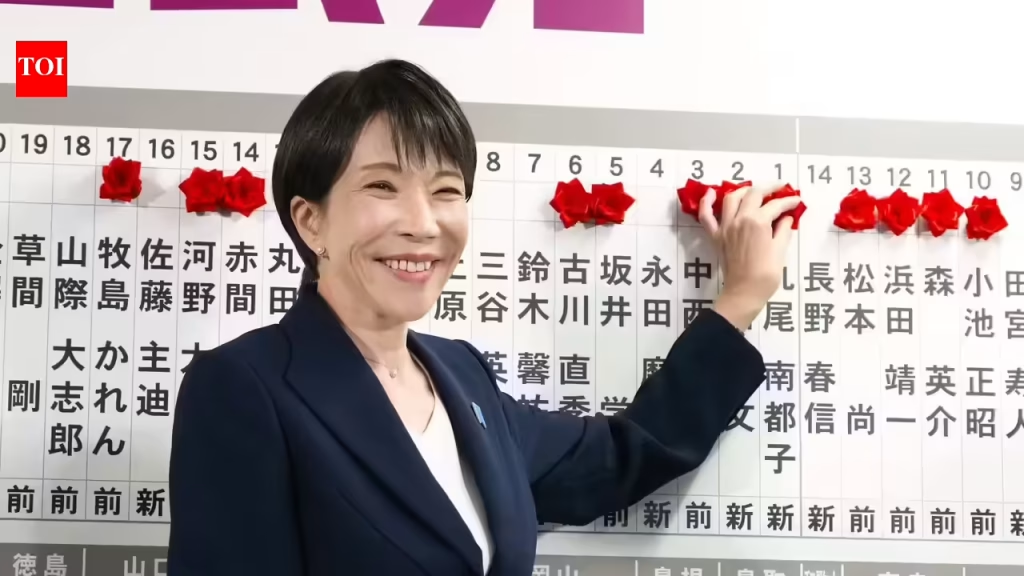
TL;DR: Driving the newsJapan’s Prime Minister Sanae Takaichi just secured a once-in-a-generation political mandate – and it’s poised to reshape how Tokyo balances deterrence against China, alignment with the US, and strategic partnering with India.Her Liberal Democratic Party (LDP) won 316 seats in the 465-seat lower house, and with coalition partner Japan Innovation Party (Ishin), she’s above the two-thirds threshold that lets her muscle legislation through even if the upper chamber resists, per Reuters-style tallies cited widely across international coverage. The snap election itself was a gamble: a rare mid-winter vote called to capitalize on her early popularity and brand as a blunt, hard-driving conservative – a bet that paid off in a landslide despite heavy snow in parts of the country. The immediate market read was bullish on political stability. Japanese equities surged to record highs after the result, with investors leaning into what the Financial Times described as a renewed “Takaichi trade” – a bet that clarity and continuity will outweigh fears of fiscal slippage.Why it matters
- Takaichi’s supermajority creates a strategic reality that China, India and the US can’t ignore: Japan now has a leader with the political runway to move faster on defense, industrial policy and alliance management – and fewer domestic constraints to slow her down.
- For China, that likely means Tokyo hardens its deterrence posture and becomes less willing to self-censor on Taiwan contingencies – even if it keeps a diplomatic channel open to prevent spirals.
- “Beijing will not welcome Takaichi’s victory. China now faces the reality that she is firmly in place – and that its efforts to isolate her completely failed,” David Boling, principal at the Asia Group, told Reuters.
- For India, it’s an opportunity: a more confident Japan is a stronger partner in the
Quad and in the supply-chain and technology agenda designed to reduce dependence on China. - For the US, the upside is obvious – a treaty ally prepared to spend more on defense and deepen industrial cooperation – but the relationship comes with a big variable: the transactional style of President
Donald Trump , and how far Washington expects Tokyo to go on budgets, basing and investment. - In short, Takaichi’s win doesn’t just stabilize Japan’s politics. It shifts the center of gravity in Indo-Pacific strategy – and forces capitals to price in a Japan that’s both more predictable in direction and more forceful in execution.
Zoom in: China – deterrence first, dialogue secondBeijing’s central problem with Takaichi isn’t merely her ideology. It’s that she’s shown a willingness to publicly describe scenarios prior Japanese leaders tended to keep implicit – especially around Taiwan and Japan’s likely role if conflict erupts.Early in her tenure, she deviated from Japan’s long-standing habit of careful ambiguity and outlined how Tokyo might respond to a Chinese attack on Taiwan, sparking what multiple outlets characterized as the sharpest China-Japan dispute in years. The blowback wasn’t abstract. Beijing signaled displeasure through a mix of diplomatic pressure and practical retaliation – from tougher messaging to discouraging tourism – and the tension is likely to persist as long as Takaichi frames defense planning around a Taiwan-linked contingency. What changes now is not her worldview, but her leverage. A two-thirds lower-house majority puts wind at her back on policies Beijing dislikes most: higher defense spending, expanded defense-industrial capacity, and potentially constitutional debates about Japan’s military posture.Investors are already front-running that direction. Bloomberg reporting on post-election trading highlighted how defense-related sectors and policy clarity are among the key expectations attached to her strengthened hand – even as markets remain sensitive to the fiscal math.Still, Takaichi’s mandate also gives her an off-ramp if she wants it. A strong leader can sometimes take a “deep breath” and lower the temperature without looking weak – an argument AFP has aired through outside analysts who see post-election room for recalibration. The likeliest path is a blend: tougher capability-building, paired with controlled diplomacy. That would mirror Japan’s recent pattern – build deterrence steadily while keeping a functional working relationship with Beijing to protect trade and prevent accidents.But the risk of miscalculation rises if Beijing interprets Japan’s moves as part of an encirclement strategy – especially if Tokyo’s defense reforms expand beyond budgets into export rules, joint production, and tighter intelligence and operational integration with the US.Between the lines: India – the quiet strategic winner
- India is rarely the loudest voice in Japan election coverage, but it may be the most quietly advantaged by Takaichi’s result.
- A Japan with political stability and a leader willing to move decisively is a better partner for New Delhi’s long game: building resilient supply chains, scaling high-tech manufacturing, and balancing China without formal alliances.
- Takaichi’s domestic agenda – industrial policy, technology investment, and defense production – creates natural touchpoints with India’s priorities. As investors price in more support for semiconductors and strategic sectors, the same toolkit can be applied outward through co-development, trusted supply networks, and infrastructure finance that competes with Chinese state-backed capital.
- Her political style also matters for India. New Delhi tends to value predictable, leader-driven decision-making in strategic partnerships. Takaichi’s large mandate reduces the chances that coalition fragility or frequent leadership turnover will interrupt multi-year projects – whether in connectivity, maritime cooperation, or technology frameworks with Quad partners.
- There’s also a defensive logic: Japan’s sharper focus on Taiwan contingencies and the East China Sea frees India to coordinate without being the primary “frontline” balancer in Asia. The more Japan and the US can credibly deter in the Western Pacific, the more bandwidth India has to focus on its own border pressures and Indian Ocean priorities – while still participating in shared initiatives.
- One caveat: Takaichi’s nationalism and emphasis on traditional values can narrow Japan’s immigration and labor-policy flexibility over time, which could constrain growth and industrial expansion – indirectly affecting the scale of Japan’s outward economic commitments. But for India, the direction of travel remains favorable: more strategic convergence, more industrial cooperation, and a stronger Quad backbone.
What they are saying
- US treasury secretary Scott Bessent wrote on X: “When Japan is strong, the US is strong in Asia.”
- Foreign ministry spokesman Lin Jian: “China’s policy toward Japan “will not change because of any single election.”
- An article in Bloomberg: Chinese leaders must now must decide whether to maintain economic pressure on Tokyo, or find an off-ramp to the dispute. Takaichi has stated she wants stable relations with Beijing, but it remains politically impossible for her to retract her comments without appearing to compromise Japan’s security.
What next: The US meeting, the fiscal test, and Beijing’s responseThree near-term milestones will determine whether Takaichi’s mandate translates into regional transformation – or a more incremental shift.Washington: Trump, burdens, and bargainingTrump has already publicly embraced Takaichi’s win, posting: “I wish you Great Success in passing your Conservative, Peace Through Strength Agenda.” That language signals ideological alignment – but also hints at expectations around defense spending and alliance postureThe core question for Tokyo is whether Trump provides reassurance on regional security while asking Japan for bigger financial and industrial commitments – the sort of tradeoff that could tighten US-Japan integration but complicate Japan’s budget politics.2) The fiscal math: tax cuts vs. market patienceTakaichi ran on economic relief measures that spooked some investors before the vote. What’s different now is that markets appear, at least temporarily, willing to assume her supermajority enables “policy clarity” rather than runaway spending. Bloomberg’s post-election reports emphasized that investors are giving her “the benefit of the doubt,” with calmer-than-feared moves in bonds and the yen. 3) Beijing’s counterplay: pressure, patience, or bothChina’s options span the spectrum: diplomatic freezing, targeted economic pressure, or selective engagement designed to split Japan from US strategy. The early signs from prior flare-ups suggest Beijing is willing to use both symbolic and material tools – tourism messaging, commercial frictions, and political signaling – to shape Tokyo’s behavior.What’s newly difficult for Beijing is the political premise: isolating Takaichi looks harder when voters just locked her in with a historically large lower-house majority. That reality encourages a different Chinese approach: test Japan’s thresholds, probe for economic vulnerabilities, and wait for fiscal strain or political fatigue to erode public support.Bottom lineTakaichi’s win strengthens Japan’s hand – but it also raises the stakes. A bolder Japan can anchor deterrence and deepen partnerships with India and the US. It can also accelerate a cycle of pressure and response with China, especially if Taiwan planning becomes more explicit.The next few months will show whether she uses her mandate to sprint – or to consolidate.(With inputs from agencies)