
Who will bell the tolls? Trump sows chaos in world waterways – The Times of India
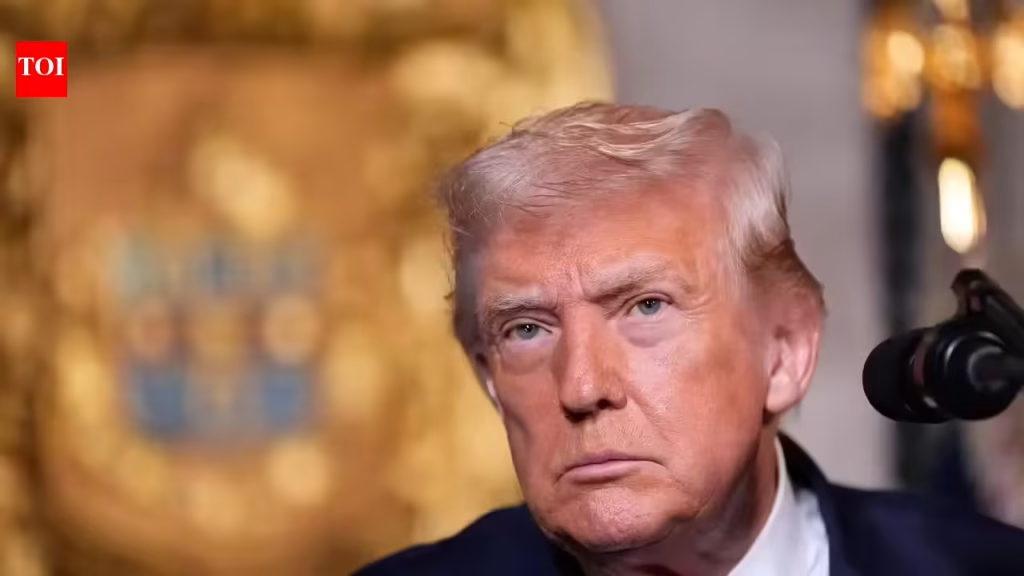
The TOI correspondent from Washington: US President Donald Trump has warned Iran to stop charging fees on ships going through the Strait of Hormuz, reversing his earlier position where he appeared to endorse such tolls and even wanted a cut of the spoils for Washington in a deal with Tehran. “There are reports that Iran is charging fees to tankers going through the Hormuz Strait — They better not be, and if they are, they better stop now!” Trump said in a post on Friday, following up with “Iran is doing a very poor job, dishonourable some would say, of allowing oil to go through the Strait of Hormuz. That is not the agreement we have!”The US President has now managed to articulate three distinct positions on one of the most sensitive questions in global maritime law: whether Iran can charge tolls in the Strait of Hormuz. First came the provocation. Asked if he would end the conflict tied to Iran’s reported toll collection, Trump, amplifying his view that “to the victor goes the spoils,” shot back: “What about us charging tolls? I’d rather do that than let them have it. Why shouldn’t we? We’re the winner.” Hours later, he floated a deal with Iran, saying “We’re thinking of doing it as a joint venture…It’s a way of securing it — securing it from lots of other people,” calling it a “beautiful” idea.The contortions have left diplomats, shipping companies, and legal scholars grappling with a question that cuts to the heart of the global trading system: who, if anyone, has the right to charge for passage through the world’s maritime chokepoints?Under the United Nations Convention on the Law of the Sea (UNCLOS), the answer—at least on paper—is unambiguous. The Strait of Hormuz, a narrow passage connecting the Persian Gulf to the Arabian Sea, qualifies as an “international strait.” Under Article 44, coastal states bordering such straits—in this case Iran and Oman—are obligated not to “hamper or suspend” transit passage. A narrow exception: states can charge fees for specific services like pilotage, tug assistance, or emergency repairs, but these must be tied to actual services, not levied as a blanket “navigation tax.”Iran’s reported move to extract toll — allegedly now in cryptocurrency— has therefore drawn swift condemnation from maritime law experts, who see it as a direct violation of both treaty law and long-standing customary practice. By some accounts, Iran can generate up to $240 million a day, given the roughly 120 vessels that transit the strait daily. Part of the confusion stems from a fundamental distinction in maritime law: the difference between natural straits and man-made canals. Artificial waterways like the Suez Canal and the Panama Canal are widely accepted as toll-based systems. Egypt and Panama, respectively, charge transit fees because these are engineered passages requiring constant dredging, maintenance, and security. The tolls are not only legal but essential to the canals’ operation, and they are applied on a non-discriminatory basis under established treaty frameworks.Natural straits, by contrast, are governed by the principle of free transit. They are not owned infrastructure but geographic inevitabilities—chokepoints through which global commerce must pass. Allowing unilateral tolls in such waterways would effectively convert geography into a tool of economic coercion. That is precisely the fear now rippling through maritime circles. If Iran succeeds in enforcing tolls in Hormuz—even partially—it could set a precedent with far-reaching consequences.Attention is already turning to the Strait of Malacca, another critical artery through which a significant portion of global trade flows. Malaysia, Singapore, and Indonesia have long adhered to the principle of free passage under UNCLOS, but one analyst warned this week that by destabilising Hormuz and bullying Panama, the US has shattered the maritime order that kept Malacca’s shipping lanes free for decades. The implications extend even further. India could, in theory, seek to impose charges on shipping routes crisscrossing the Indian Ocean, while China—already assertive in the South China Sea—might attempt to formalise “administrative fees” for passage through waters it claims as sovereign. In an era of fraying international norms, it now appears the temptation to extract revenue—or exert leverage—could prove irresistible. For the global economy and shipping, including for India, the stakes are enormous. The Strait of Hormuz handles roughly a fifth of the world’s oil supply, while accounting for 40 per cent of India’s imports (down from 55 per cent in 2020 as New Delhi has diversified to Russia, USA, and now Venezuela) and 90 per cent of its LNG. Even the hint of tolls—or the threat of enforcement—can send insurance premiums soaring and disrupt supply chains from Rotterdam to Mumbai to Tokyo (also vulnerable). Japan and other energy-dependent economies have already voiced concern, warning that the combination of conflict and commercial exploitation could destabilise markets. “If you hadn’t started this war, the Strait of Hormuz would still be peaceful and free,” one angry critic told Trump on X, capturing a sentiment widely shared among US allies even as vice-president JD Vance was flying over the region into Pakistan.