
Assam Assembly Elections: Assam assembly elections 2026: How delimitation drew new battle lines in state; who stands to gain | India News – The Times of India


NEW DELHI: In the high-stakes battle for the Assam assembly elections, while poll promises, manifestos, alliance fine-tuning and campaigning will shape the outcome, a new political mapping of the state is also set to play a key role.While in most states the opposition has alleged that special intensive revision of electoral rolls is being used to cut into their vote base, in Assam the delimitation exercise has altered the political landscape without barring any voter.
The delimitation exercise for Assam’s assembly and Lok Sabha seats was carried out in 2023. The number of seats remained 126 — unchanged since 1976 — but the new political map has altered their composition, reshaping the landscape for all major parties.The poll panel categorised districts into A, B and C based on population density, and relied on the 2001 Census instead of the 2011 Census.“A – Districts having population density less than 304 persons per sq. km.; B – Districts having population density between 304 to 372 persons per sq. km.; C – Districts having population density more than 372 persons per sq. km,” the ECI said in its methodology.For A category districts, seats were determined by deducting 10 per cent from the state average population, while for C category districts, the Election Commission added 10 per cent to the state average population while finalising seat allocation.Ahead of the process, the state cabinet merged districts, reducing their number and altering the administrative framework. The commission later froze new administrative units from January 1, 2023, effectively locking these changes for delimitation.Why it mattersDelimitation aimed to ensure equal representation. In Assam, the data shows some improvement, but significant gaps remain. In the pre-delimitation map, the gap between the smallest and largest constituencies had widened to 3.54 times.Under the post-delimitation voter rolls, this ratio has improved to 3.15. While this marks progress, one constituency still has more than three times the number of electors as another.
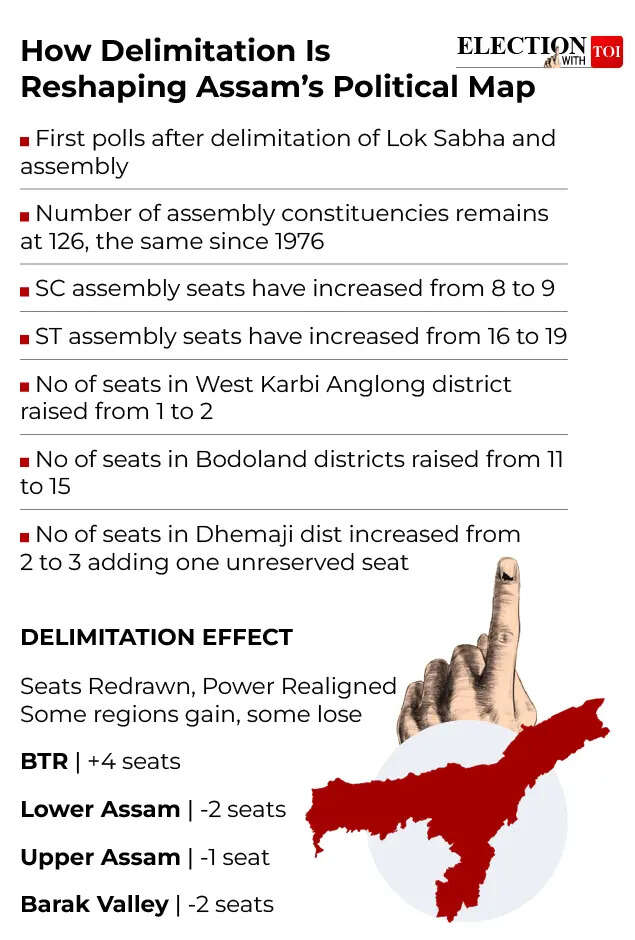
The disparity is also visible at the district level. Based on population, Kokrajhar and Dhubri highlight the imbalance. Kokrajhar has roughly one seat per 1.77 lakh people, while Dhubri has one per 3.25 lakh. This effectively gives a voter in Kokrajhar significantly greater representation than one in Dhubri.According to chief minister Himanta Biswa Sarma, the exercise has made indigenous communities decisive voters in 103 of the 126 seats.The new political map has also dismantled several party bastions, forcing all major players to recalibrate their strategies.Reserved seats for SC and STThe number of seats reserved for Scheduled Castes and Scheduled Tribes has increased to 9 and 19 from 8 and 16 earlier.The Bodoland Territorial Region has gained seats, rising from 11 to 15, while West Karbi Anglong has gained one. Seat losses are concentrated in densely populated districts, many with Muslim majorities, with Barpeta dropping from eight to six seats.The Barak Valley’s tally has reduced from 15 to 13, with Karimganj and Hailakandi losing one seat each.Three constituencies with a history of electing Muslim legislators have been reclassified. Goalpara West is now reserved for Scheduled Tribes, while Barpeta and Naoboicha are reserved for Scheduled Castes.
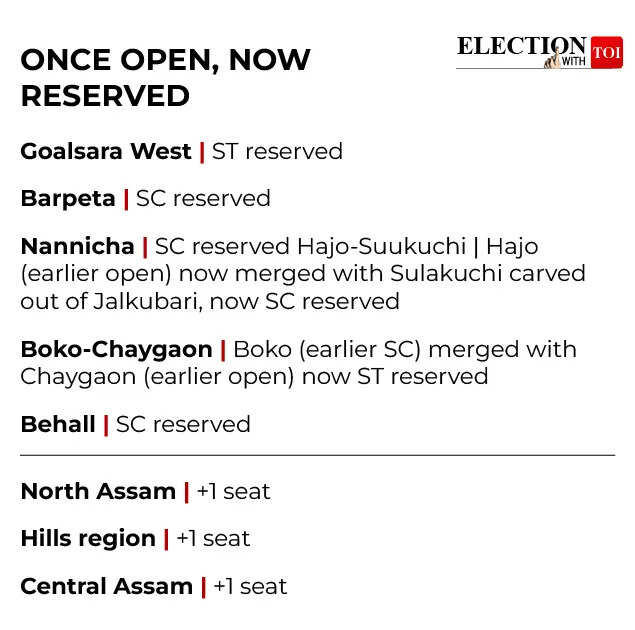
The reconfiguration has diluted pockets where Bangladesh-origin immigrant Muslims were earlier decisive voters. As a result, Muslim-dominated constituencies have declined from around 35 to 24 — areas where AIUDF and the Congress were traditionally strong.The state has also long faced the issue of Muslim infiltration from Bangladesh, with many having had their citizenship regularised under the Assam Accord of 1985, while their original identity remains entrenched.Additionally, delimitation has diluted several constituencies where Bangladesh-origin immigrant Muslims were previously decisive voters, reducing the number of seats where parties such as the All India United Democratic Front (AIUDF) and the Congress traditionally held sway.Muslims constitute about 37% of Assam’s 2.49 crore voters. In the outgoing assembly, there are 30 Muslim legislators — 16 from the Congress and 14 from the AIUDF.Who benefits from thisThe BJP-led government’s drives to evict encroachers from forest and government land — largely Bangladesh-origin Muslims — along with land pattas granted to indigenous landless families and descendants of tea garden workers brought from the Chota Nagpur plateau during the British era, have positioned chief minister Himanta Biswa Sarma as a strong leader projecting himself as a protector of Assamese identity — ‘jati’, ‘mati’, ‘bheti’.Addressing rallies in Patharkandi, Hailakandi and Silchar on the last day of campaigning for 13 assembly constituencies going to the polls on April 9, Shah cast the election as a decisive contest over illegal immigration.Alongside this, Sarma has taken a tough stance against “Miya Muslims” and targeted the community ahead of the polls, reinforcing what has remained the BJP’s core poll plank since 2016.
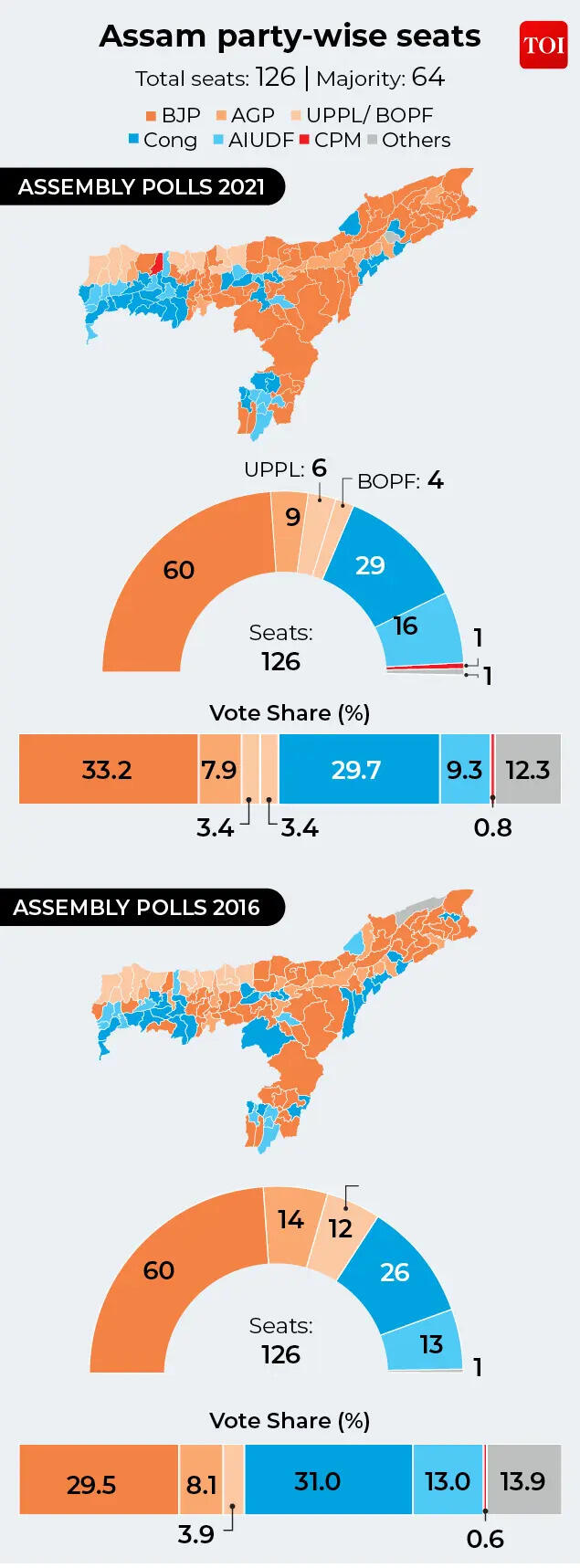
During the campaigning, BJP stalwarts like Prime Minister Narendra Modi and Union home minister Amit Shah have emphasised eliminating infiltration from the region in the next five years.It has also accused Congress of settling “ghuspetias” in Assam for political benefit and said the party’s opposition to the Citizenship (Amendment) Act, along with its role in introducing the Illegal Migrants (Determination by Tribunals) Act, 1983, showed its intent to shield illegal immigrants.For the Congress, delimitation has emerged as a major challenge. Its traditional bases have been fragmented, forcing it into alliances with regional parties. While it remains the principal opposition, its ability to consolidate anti-incumbency sentiment has weakened.This has pushed the Congress to stitch together a mega alliance of regional parties — Assam Jatiya Parishad, All Party Hill Leaders Conference, CPM and CPI(ML). While it remains the principal opposition, its ability to consolidate anti-incumbency sentiment appears weakened.Amid the BJP’s identity push, the AIUDF, led by Badruddin Ajmal, faces the sharpest impact. Its strongholds in Muslim-dominated areas have been diluted, leaving it with fewer winnable seats. The party’s minority-centric strategy appears to be losing traction in constituencies now dominated by indigenous voters.The last delimitation in Assam was conducted in 1976, based on the 1971 Census. For nearly five decades, the state’s political geography remained unchanged despite shifts in demographics, migration and population.The upcoming elections are therefore not just a contest for power, but a turning point in Assam’s political trajectory — the first major realignment of constituencies in 50 years, reshaping influence and redefining political stakes.